


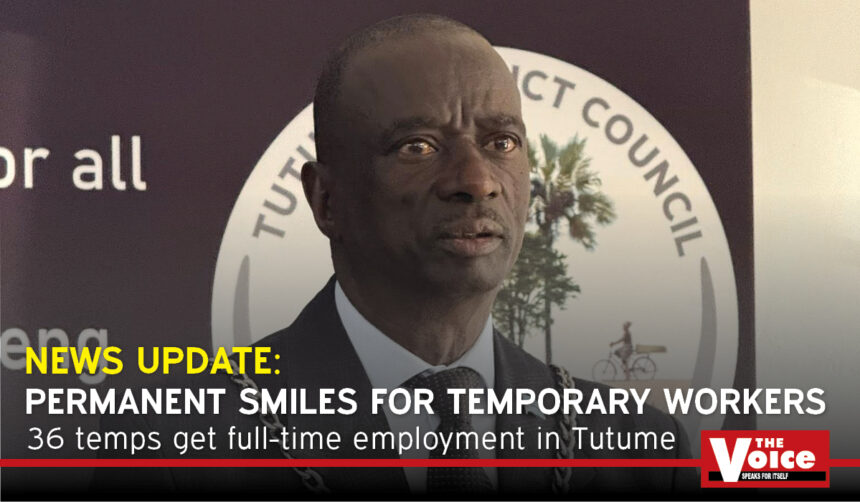
36 temps get full-time employment in Tutume
The government’s promise to overhaul the public sector by doing away with both temporary contracts and outsourcing of non-core services is being put into action in the Tutume District.
According to Council Chairperson, Tabona Masole, 36 temporary employees have been successfully absorbed into the permanent and pensionable establishment, comprising 25 cleaners, 10 night-watchmen and one grounds man.
Masole hailed the Umbrella for Democratic Change (UDC) government for taking a deliberate decision to reintroduce insourcing within the public service.
“This initiative is aimed at strengthening internal capacity, improving service delivery efficiency, and maximizing value for public resources,” he explained.
The Chairman further said insourcing enhances long-term sustainability by reducing an over-reliance on external vendors and consolidating critical functions within the public service structure.

Masole revealed the absorption process was executed without an initial budget provision.
“However, a comprehensive data collection exercise has been finalized and submitted to the Directorate of Public Service Management (DPSM) to determine the exact establishment requirements and associated implementation costs,” he said.
The new government made a commitment to absorb 490 lower-level temporary employees into permanent positions effective 1 April.

Following findings by the Botswana Institute for Development Policy Analysis (BIDPA), the new administration chose to prioritize vulnerable contract workers into permanent and pensionable positions to restore job security and dignity.
The study found that most temporary workers earned low wages and were employed on short-term contracts, often ranging from three months to a year; once contracts elapsed many were left stranded.
This uncertainty, according to the study, affected the employees’ ability to plan their lives and access financial services such as loans.
The BIDPA study also discovered that some temporary employees had worse working conditions compared to the outsourced ones, working for government.
The new dispensation directly tackles the challenges of job insecurity, inconsistent pay, and contract exploitation that previously burdened many temporary and outsourced civil servants.
The newly absorbed workers will receive standardized benefits, which include medical aid, pension fund contributions and a minimum baseline wage of P4, 000 per month.