
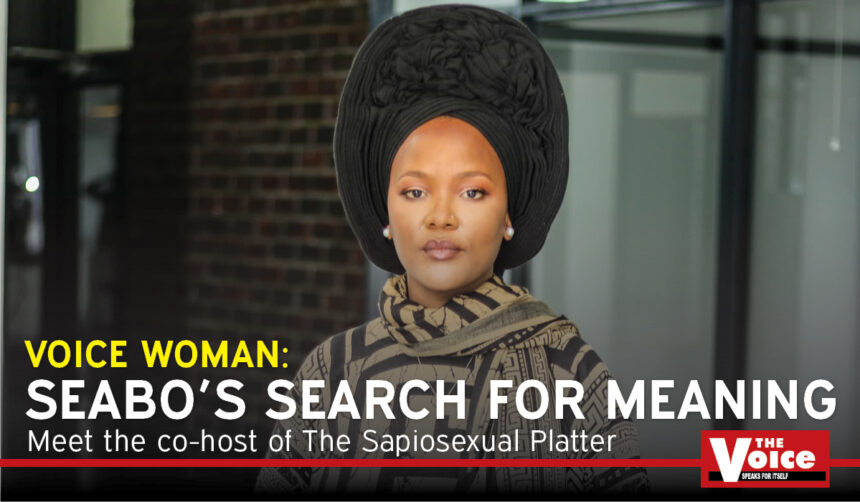
Meet the co-host of The Sapiosexual Platter
Belle Keoseme Amantle Seabo-Ahme’s recent viral moment ignited heated debate online.
As co-host of the Sapio Sexual Platter podcast, alongside longtime friend and fellow legal professional Shathani Somolekae, she drew both praise and criticism for her remarks on protests against illegal immigration in South Africa.
The podcasting pair’s careful candor underscored the need to denounce both xenophobia and lawlessness, while also recognising the legitimate struggles many South Africans experience due to illegal immigration, a crisis often rooted in the same systemic failures that force migrants to leave their homelands.
The 33-year-old Ramotswa native, a graduate in International Development and Law from Norwich, England, sits down with Voice Woman for a lively conversation reflecting on a life shaped by geographical, intellectual, and spiritual journeys.
Seabo straddled multiple environments throughout her formative years, an experience she credits with fostering her openness to change and a global mindset. “In Standard 3, I transitioned from St. Conrad’s, a public school in Ramotswa, to Crescent Primary School in Lobatse. There, I was made to repeat a year due to my limited proficiency in the English language. This experience exposed me to how language can influence perceptions of intelligence and potential, even though
I was academically gifted and quickly rose to the top of my class. I later went to settle in Gaborone with my mum, from Botlhale Primary to Tlogatloga Junior School where I also skipped a year, hence I was appointed prefect; I finished high school at 16 as a result,” she recalls.

Despite excelling in sports – particularly netball and athletics – and nurturing a passion for the arts through music, dance, and creative expression, she was guided toward more traditional academic paths, ultimately leading her into law.
Her decision to study law in the United Kingdom was moreover driven by both practical considerations and a strong family tradition of public service, diplomacy, and international trade.
“My mother served as a trade attaché at the Botswana Embassy in Belgium, and my close friend, Shathani, whose mother was a judge, shared my passion for law and literature. Our friendly rivalry at St. Joseph’s College fuelled our ambition to pursue legal studies.”

At the University of East Anglia, exposure to sociology and international development shifted something foundational.
“I got exposed to philosophies and concepts to do with humanity, and found it intriguing.”
For the first time, Seabo began to interrogate the systems that had shaped her education and identity. A growing interest in language, power, and opportunity emerged – particularly how children across Africa are assessed and constrained by education systems that do not reflect their linguistic realities.
“A research project on language and learning in Tanzania deepened this inquiry, and reinforced my focus on educational inequality and the broader politics of knowledge production in Africa. I studied the impact of language and education in Africa,” she reflects, adding although she completed her law degree under sponsorship obligations, she deliberately pursued electives in development, gradually expanding her intellectual focus beyond legal practice.
Her studies unfolded alongside personal hardship. While working in a mental health institution to fund her postgraduate ambitions, she also navigated the emotional and financial aftermath of her mother’s survival of a traumatic divorce and gender-based violence. “I became very aware that we were recuperating as a family, so I saved diligently to support my own education.”
After completing her law degree in 2014, she went on to pursue a Master’s in International Development.

“But my mum insisted I do an MBA, so I did two master’s programmes concurrently – one online and the other full-time. It was hectic, and I eventually quit the MBA. My interest was media so I studied Media and Development in Practice, and topped that class. There, I refined a growing interest in media representation and how Africa is portrayed globally – often reduced to narratives of poverty, crisis, and dependency, while its complexity, innovation, and resilience remain underrepresented.”
By the time she returned to Botswana in 2015, she carried not only qualifications, but questions.
She wanted to contribute to African development, but the path forward was unclear.
“So, I turned to God for clarity and direction, which unexpectedly, came through a book, ‘Instinct’ by T.D. Jakes; it pushed me toward an unfamiliar starting point: beauty,” she recounts, adding her mother was supportive.
At the time, Botswana’s makeup industry was still in its infancy. Despite her academic background and the pressure to pursue conventional employment, she began building something from scratch.
“With limited resources, self-taught video skills, and savings earned through institutional work, I started creating beauty content from my family’s living room – filming tutorials, educating audiences, and exploring makeup as a form of confidence-building rather than mere aesthetics.”
Those early years were challenging. “There were no established systems, few mentors, and limited public understanding of the industry I was trying to build; I offered free services, taught classes, and slowly built trust in a market that did not yet fully exist,” she recalls, adding over time, her work began to resonate, with clients like Nnunu Ramogotsi and Kearoma Rantao.
“I developed a reputation not only for technical skill, but for the ability to help clients see themselves differently. A studio followed. After 2 years, a former client, Bojotlhe, contacted me about working with high-profile clients, like Basetsana Kumalo,” she narrates.
A turning point came when a single photograph she captured at a wedding went viral internationally. The image was shared across platforms, reaching audiences far beyond her immediate network.
“That was how my following shot through the roof! Overnight, visibility shifted from local recognition to global attention. After years of persistence and depression, I found myself validated. I was so grateful to God for the breakthrough.”
More opportunities followed. Eventually, connections led to public figures, such as former first lady Neo Masisi in 2018.
“Working with prominent clients like Mma Masisi was a blessing because she got to know me better. My qualifications aligned with her work, so she invited me to collaborate,” Seabo-Ahme recalls.
The partnership opened doors to larger initiatives in education, children’s development, and women’s empowerment. She began shaping programmes, leading outreach, and telling stories that bridged development with public engagement.
“At the same time, I worked to professionalise the creative sector; training up-and-coming makeup artists, creating structured systems within my business, proving that beauty is a legitimate economic pathway for women,” she says.
But success brought its own complications. After years of rapid growth, she reached a point of exhaustion she could not ignore. Despite continued business activity and a growing team, she describes a period of deep depletion, where motivation faded.
So, travel became both an escape and a mirror for Seabo-Ahme, carrying her first to Nigeria and later to Mumbai, India, where she immersed herself in structured spiritual practice.
“Meditation and spirituality became part of my attempt to understand not only fatigue, but meaning,” she reflects.
Ultimately, she discovered that building anything meaningful requires periods of withdrawal, moments that ultimately usher in new chapters. Now, Seabo-Ahme’s story is less about constant reinvention and more about a growing willingness to interrogate the very definitions of success she once relentlessly pursued.