


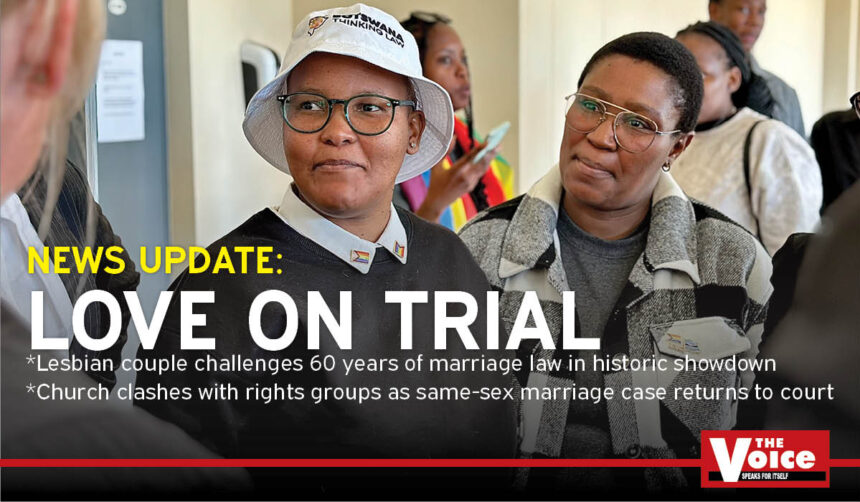
*Lesbian couple challenges 60 years of marriage law in historic showdown
* Church clashes with rights groups as same sex marriage case returns to court
What began as a personal fight for recognition by two women in love has evolved into one of the most consequential constitutional battles in Botswana’s modern history.
Now religious bodies, cultural groups, rights organisations and legal experts are all seeking a place in the legal proceedings that could redefine the country’s understanding of marriage.
Bonolo Selelo and Tsholofelo Kumile have approached the High Court seeking to strike down provisions of Botswana’s Marriage Act that prohibit same-sex marriage.
The couple argues that denying them access to civil marriage violates fundamental rights guaranteed under the Constitution, including equality, dignity and freedom from discrimination.
At the heart of the case is a question that has ignited intense national debate: can two consenting adults be denied the right to enter into a civil marriage solely because they are of the same sex?

The case has attracted widespread attention from both supporters and opponents of marriage equality, transforming what began as a personal quest into a national conversation about constitutional rights, culture, religion and the future of the institution of marriage in Botswana.
Selelo drew parallels between their struggle and one of the defining moments in Botswana’s history. She referenced the marriage between the country’s founding president, Sir Seretse Khama, and Lady Ruth Williams Khama, whose interracial union in the late 1940s faced fierce political and social opposition.
“We come from a long tradition of Batswana who stood up for love despite opposition,” Selelo said.
She added that Botswana has a long tradition of individuals standing up for love despite resistance.
However, she noted that religious organisations seeking to join the case are expected to advance arguments rooted in Christian beliefs and values.
Meanwhile, the Lesbians, Gays and Bisexuals of Botswana (LEGABIBO) has launched its own bid to join the proceedings. The organisation says the outcome of the case will affect not only the couple at the centre of the matter but also countless members of the LGBTQIA+ community whose aspirations and rights are directly implicated.
“This matter has implications far beyond the individuals involved,” said LEGABIBO CEO Nozizwe Ntesang. “The voices of lesbian, gay and bisexual citizens must be heard in a case that could shape their future.”
For more than two decades, LEGABIBO has advocated for equality and the protection of LGBTQIA+ rights in Botswana. Supported by the Southern Africa Litigation Centre and represented by Rantao Attorneys, the organisation contends that the constitutional issues raised in the case extend beyond the immediate parties and carry significance for future generations.
However, advocates of marriage equality are not the only voices seeking to be heard.

Among those applying to join the proceedings are the Dingwetsi Association, together with the House of Churches and the Evangelical Fellowship of Botswana.
The groups are expected to oppose any move towards the legal recognition of same-sex unions.
Dingwetsi Association president Grace Silver has argued that marriage, according to Botswana’s cultural traditions, is intended to exist between a man and a woman.
She further expressed concerns that because Botswana has a relatively small population, legalising same-sex marriage could have demographic implications.
“We are a small country and this could affect the population,” she said, arguing that recognising same-sex unions would be disrespectful to what she described as the sanctity of marriage.
Adding another dimension to the proceedings is Human Rights scholar Dr Onthatile Moeti, who has also sought to participate in the matter in the capacity of a friend of the court, a role designed to assist judges by offering independent legal perspectives on issues of public importance.
The High Court had initially scheduled proceedings to allow parties seeking joinder to present heads of argument explaining why they should be admitted into the case.
However, some parties had either failed to file their submissions or had submitted them outside the prescribed timeframes.
As a result, the matter was adjourned to July 14, when the court will hear arguments on the various joinder applications and determine which parties will be formally admitted into the proceedings.
The decision on who gets to participate could prove pivotal in shaping the arguments that ultimately come before the court.
Whatever the eventual outcome, the case has already emerged as one of the most significant legal and social contests of the post-independence era, touching on deeply held beliefs about family, faith and identity while testing the extent to which constitutional guarantees of equality and dignity apply to all citizens.
The world is watching as this case is simply not a big one just for Botswana but for Africa as a whole where as sex sex marriage remains illegal in most parts of Africa except for South Africa.
As Botswana’s highest courts prepare to hear competing visions of marriage and rights, the nation finds itself confronting a question that reaches beyond the courtroom: whether the Constitution’s promise of equal treatment extends to same-sex couples seeking recognition under the law.
The answer, many believe, could leave a lasting mark on Botswana’s legal landscape and define the country’s human rights discourse for generations to come.