


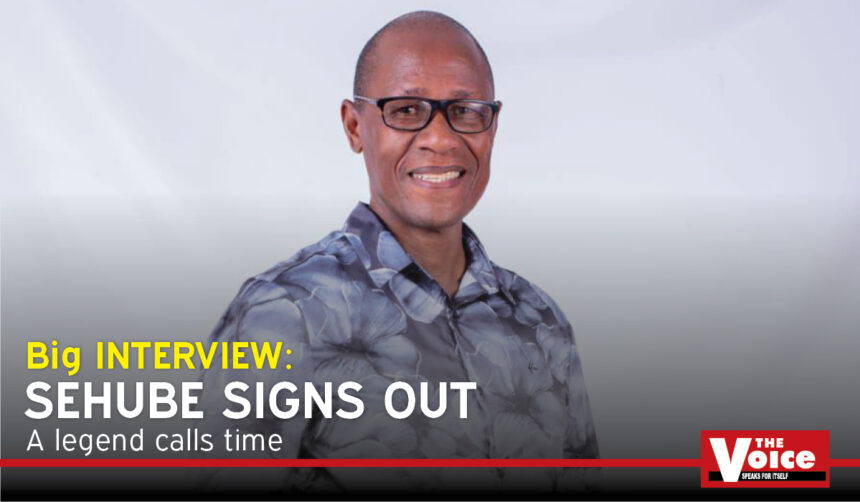
For the past 36 years, Bampeile Mascot Sehube’s gravely tones have been an ever-present on Radio Botswana.
A symbol of consistency, passion and excellence, the respected newsreader turned every broadcast into a trusted companion for listeners nationwide.
However, all good things must come to an end.
Turning 60 on 8 August, the Nata native’s birthday will be tinged with sadness as he calls time on his distinguished career, leaving the airwaves to enjoy well-deserved retirement.
Affectionately known as BMS to his colleagues, the legendary broadcaster reflects on his remarkable journey in this heartfelt chat with Onneile Ntokolo…

You’ve become one of Botswana’s most recognisable voices – but take us back to the beginning, how did your journey into radio broadcasting start?
True that! When I completed my Form Five at Shashe River Senior Secondary School in Tonota in 1988, where I also did my Junior Certificate, I went back home to Nata to stay with my mother and siblings. When I was with my peers at home, it just came to my mind that I want to work at Radio Botswana after I listened to the voice of a certain guy named Gagoomang Mosi, who had gone to Gaborone to look for job and was employed as an announcer at Rb1. I was inspired and motivated when I listened to his voice over the airwaves because it reminded me of my ambition to break the airwaves when I used to listen to Rb1 during my primary school days. When I was with my friends, I never stopped telling them that I am going to work at Radio Botswana and they would laugh and make fun of me. They said I was extremely ambitious; some said I should forget about that silly untold dream and concentrate on how I would go to my grandfather’s cattlepost because that was where they believed I belonged since I obtained a grade C in my Form 5 – that is Cambridge Examinations by them. That did not discourage me, rather it encouraged me more. In July 1990, I just said ‘enough is enough; I am going to Radio Botswana to demand what belongs to me!’ I went to Radio Botswana the following morning and I was told to come for an interview the next day. Three months later I received a letter of employment: on 25 October 1990 duty called (smiles).
Oh wow, those were the days! 36 years later, do you remember your very first day behind the microphone at RB1?
Yes! I remember the first day I was on the airwaves, which took me less than a week because my supervisor felt I was ready when he auditioned me. I was nervous – it felt like I was presenting the programme ‘Tatedisoya Dikgang/News Reel’, with people watching me live! At first, it felt like a dream, rather than a career, but as I gathered my confidence, I took advantage of the lovely support I got from my colleagues, especially the engineers and started doing radio adverts, thus my voice popularity spread like veld fire on the airwaves.
Every broadcaster has that one unforgettable moment on air – what’s yours?
I always remember when it was my first year working at an out station in Francistown in 2007. My colleague, my driver, Mr Tanyala Mabele came with a story idea about three villages between Tutume and Maitengwe, whose dikgosi were claiming superiority over each other. I visited the three leaders and recorded them regarding the issue and ran the story on Tatedisoya Dikgang. The story drew attention to their leadership of Bangwatobogosi who responded positively to resolve the dispute and it made me proud. Another one was when I was based in Serowe in 2018, when the then President Dr Eric Masisi was addressing a kgotla meeting in Letlhakane village in Boteti. The meeting was broadcast live, as such there was supposed to be a radio presenter in Letlhakane. Unfortunately, or should I say fortunately for me, Radio Botswana could not send one, due to issue beyond their control at the headquarters. The meeting was left with about ten minutes to commence and my Director Ms Keitirele Mathape contacted me and pleaded with me to do the presentation. I was there to cover for news and I had never done a live presentation before. It was going to be my first! I agreed with the Director and collected myself despite the short notice. I was cool, calm and collected and at the end my presentation the Director was delighted that I did not disappoint (smiles).

Talking of adapting, Radio has evolved tremendously over the years. From the days of traditional broadcasting to the digital age, what are the biggest changes you’ve witnessed?
Great question! When I joined Rb1 in 1990, there were no computers, even recorders were not similar to the current ones. We were using typewriters to write our stories and scripts. As such, we had to be extra careful not to make mistakes, which was a big challenge for a newcomer. You had to learn how to use a typewriter and how to hunt letters with your finger hanging on the air waiting to hammer them correctly. It was quite an amazing experience! One would at the same time admire the speed and accuracy displayed by the experienced colleagues and get inspired. As for recorders, we used equipment called ‘Marantz’ which was using tapes not memory cards like the current one. Even when editing, we used tape cutters such as razor blades to remove what is not needed in the tape. These challenges acted as a motivation for one to be punctual at work as well, as time management for the bulletin or radio programmes as scheduled. At first, I was frustrated when I met with difficult interviewees, but such challenges strengthened me.
What does it mean to know that people have grown up listening to you?
At the beginning when I met people who imitated my voice I felt like melting or running away and thought they were mocking me at times. I was shy as a boy from a rural village; for me these followers flocked a lot, too much. The worst part was that I was a football player for a second division team named, City Eagle FC, where I commanded a large number of fans as a player and as a Radio Botswana Programme Producer and Presenter. The last part built my confidence as I started realising that those who were imitating me were just giving feedback that Batswana like, love and enjoy what I am doing for them as a presenter of Tatedisoya Dikgang.
What’s the funniest or most unexpected thing that has ever happened to you while live on air?
(Chuckling) Honestly, the people who trained me taught me that I should be extra cautious when on air; as such I have never created any room for mistakes when live on air.
How about the toughest obstacle you’ve faced in broadcasting?
The toughest thing in my career was when I had to work on an urgent story but my source would not release the necessary information required giving me an unfavourable time, compelling me to travel long distance to their location to convince them that I want to beat the deadline. Sometimes it will be the issue of power going off when you are still working on a story.
If you could interview absolutely anyone, living or departed, who would it be, and what is the one question you’d make sure to ask?
Well, I would interview Moemedi Kebopetswe, who had taken over from me at the News Reel Programme. He retired from Rb1 last year. I would like to know from him how life is after retirement?
It’s obvious you still love your job, are you not tempted to continue?
I feel I have done enough for the country – I cannot ask for a contract extension, that’s why I didn’t try delay retirement. But should I be offered one, I would gladly take it.

Looking back, what achievement in your broadcasting career are you most proud of?
During my career as a Broadcast Journalist, I have learnt a lot. It has opened my eye and ears on other profession, amongst them health, courts, road safety, actually life in general. When I joined Rb1, I was a quite person, a bit reserved, afraid of expressing my views even when given an opportunity. I was not a team person, I believed in working in silos, which was not a good thing. But my profession taught me that no man is an island.
What advice would you give to young Batswana who dream of one day becoming respected radio presenters and broadcasters like yourself?
Respect begins with you as an individual; achieving your dreams comes with dedication, resilience and hard work. Do not give up on your dreams, because persistence is key!
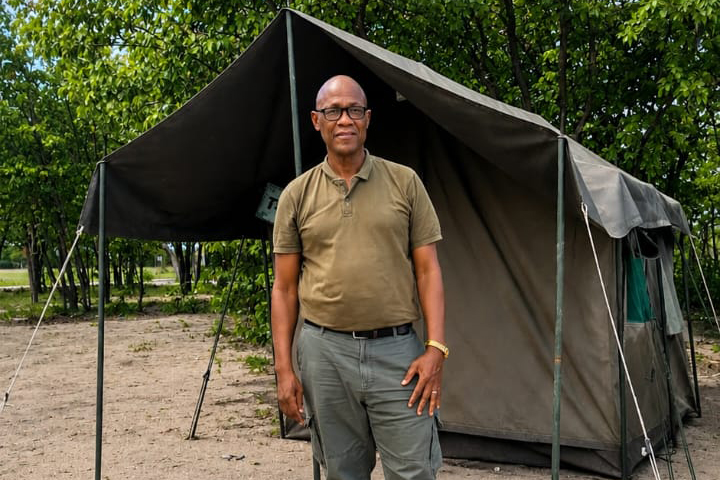
Who is BMS when the microphone is switched off?
BMS is a subsistent farmer, small livestock farming is my passion. Having travelled almost all the corners of Botswana, I have learnt a lot, which is why I would prefer small livestock and ploughing enough to feed small livestock not commercial farming.
How do your family and close friends describe you? Is the person they know different from the one listeners hear on the radio?
My family and close friends find no difference in the way I conduct myself because I am still the same Bampeile they know – I don’t demand to be treated as someone special because of my work status. At first my friends were trying to treat me like a delicate object but I made them see their usual friend and we continued to socialise as we used to. I also made them understand that I have little time with them because the bulk of my time is reserved for my family when I am not at work.
Outside of work, what do you do?
Obviously, my hobby is watching football as a former football player. Had it not been because of the distance I would be at the farm because that’s what my grandfather taught me.
And what are you most looking forward to about retirement?
I wish to see myself enjoying free time with my family. This should be a time to relax, do soft work not hard labour. I believe I have worked enough, as such I need to take hands off straining myself both physically and emotionally; I want to relax not kill my muscles!
Thank God It’s Friday! What are your weekend plans?
I will be spending my weekend with my family indoors, sometimes we go out to a restaurant to dine there and come home. My wife and I like cooking for ourselves most of the time and honestly speaking both of us do not have friends, unless we visit our relatives from both sides. As members of the ZCC, that is where we also spend our leisure time.
Sign in: Dumela. Moreetsithulaganyokeyoneya Tatedisoyadikgangmmephirimanengeno e go kopanya le nna Bampeile Sehube.
As I sign off: Mme kana e ne e go tshwaretsehela go le kalo Thulaganyoya Tatediso ya dikgang phirimaneng eno mme o ne o e neelwa ke nna Bampeile Sehube.
Stay blessed, as I enter my new chapter of life named ‘RETIREMENT’.