




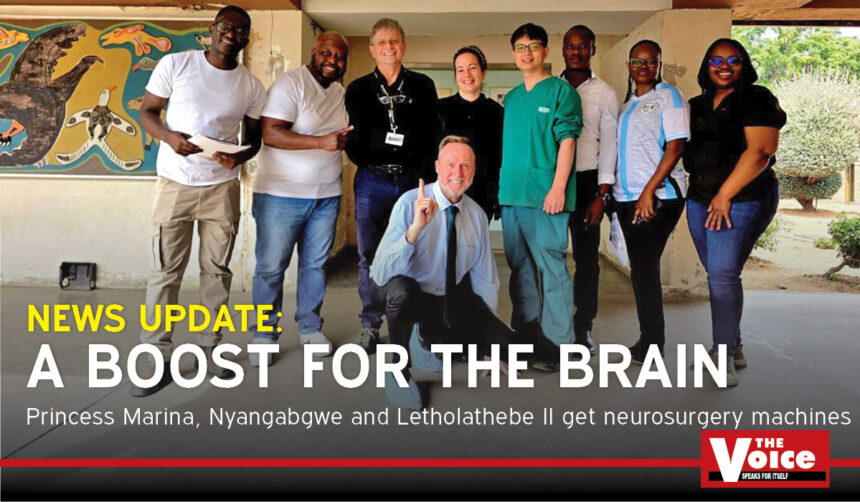
Staff trained up as Princess Marina, Nyangabgwe and Letholathebe II get neurosurgery machines
In a rare positive development for the country’s flailing healthcare system, a group of 22 medical professionals and biomedical engineers have been trained on newly procured, state-of-the-art neurosurgery equipment.
The specialised, day-long training focused on the operation and maintenance of four Cavitron Ultrasonic Surgical Aspirator (CUSA) machines recently purchased by the government.
Distributed across three major public hospitals, the high-tech surgical devices enhance precision in complex brain and spine surgeries.
Princess Marina Hospital (PMH) received two machines, while Nyangabgwe Referral Hospital in Francistown and Letsholathebe II Memorial Hospital in Maun were given one each.
Speaking to The Voice, Babo Tlhabano, the Director of Solitic (Pty) Ltd – a Gaborone-based company serving as the official local neurosurgery representative in Botswana – revealed the training was delivered entirely free of charge to the state.

“The sessions were facilitated by technical experts and local distribution partners, ensuring that the personnel operating and maintaining the infrastructure received world-class instruction,” he explained.
The facilitation team included Jason Thompson, Head of Sales and Marketing for Neurosurgery at Baroque Medical, a South African-based supplier of medical devices, capital equipment, and pharmaceutical products.
Tlhabano further noted the rigorous programme was designed to bridge the gap between clinical excellence and technical maintenance.

“Medical staff focused on the CUSA Excel system setup, pre-use safety checks, console operation settings, and proper handpiece handling and tubing assembly during sensitive procedures,” he added.
Tlhabano revealed the hospital engineering teams received specialized instructions covering technical checks, troubleshooting, cleaning protocols, and long-term maintenance considerations.
“This dual approach ensures the public health system can independently care for the equipment, minimizing downtime and maximizing the lifespan of the country’s new multi-million Pula medical assets. The integration of these CUSA machines marks a significant step forward in reducing the need to refer local neurosurgical patients abroad, which has been a long-standing concern,” he concluded.