
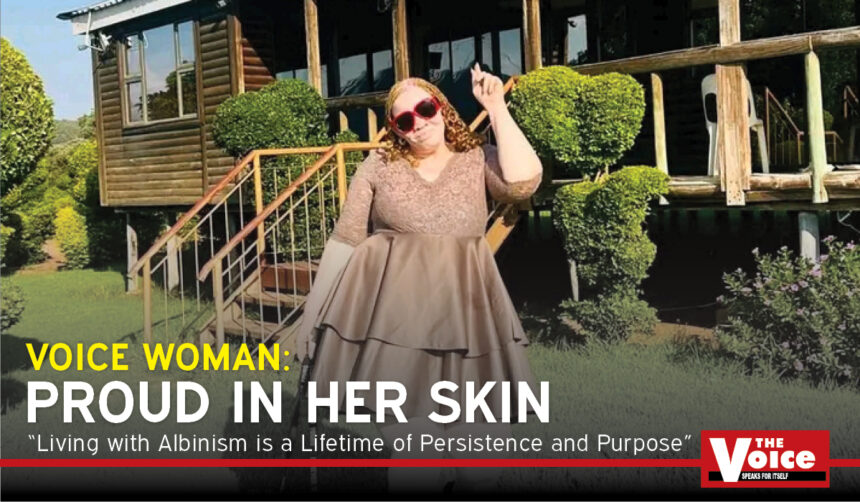
“Living with Albinism is a Lifetime of Persistence and Purpose”
For Shupikayi Powe, living with albinism is not a limitation but a lifelong mission.
From a young girl finding her voice at Ithuteng Primary School to becoming a recognised advocate for people living with albinism, Powe has spent decades challenging stereotypes, demanding inclusion, and fighting for a society where people are valued for who they are rather than how they look.
Her advocacy has taken her from classrooms and communities to national leadership platforms, where she has engaged policymakers and former president Festus Mogae in her pursuit of better support systems for people with albinism.
One of her key priorities has been ensuring access to free sunscreen and essential skincare products through the public healthcare system.
As the world marked International Albinism Awareness Day in June under the theme, ‘Proudly in My Skin: Celebrating All Skin Tones,’ Powe reminded society that people with albinism are not defined by myths or misconceptions.

She highlighted the challenges many people with albinism continue to face, including discrimination, social exclusion, barriers to education, visual impairment, limited healthcare access, and the increased risk of skin cancer caused by prolonged exposure to ultraviolet rays.
“My message is simple. People with albinism deserve dignity, acceptance, and the freedom to live without fear or prejudice. They should be proud of who they are. Our skin is beautiful. Our life matters. Our dreams are valid, and our voice deserves to be heard,” the mother-of-four wrote in a message shared on her social media platforms.
Born in May 1978, the Moshupa native’s childhood was shaped by both challenges and determination. Growing up with low vision meant that education required additional support, but her parents refused to allow her circumstances to define her future.
They searched tirelessly for opportunities, taking her to schools in Botswana and Zimbabwe and seeking specialised medical assistance as far as Zambia. Their belief was simple: she deserved the same opportunity as any other child to learn, grow, and succeed.
“When I was at Ithuteng, my naivety led me to believe that our Headmistress, Mma Mmusi, was my mother, which is why I often went to her office whenever I needed something,” she recalls.
“Had Mma Mmusi not been as nurturing and passionate as she was, my childhood experience would have been far less happy.”
That support gave her confidence to speak up for herself. When then president, Sir KetumileMasire, visited her school, Powe was not afraid to share her challenges and advocate for herself and other learners living with albinism.
A major turning point came during her time at Marang Junior Secondary School, where the late school head Mma Sivetsen (nee Dibotelo) recognised that Powe’s difficulties were not due to a lack of ability but a lack of suitable support.

“She was transferred to Molefhi Secondary School in Mochudi, which is home to Botswana’s specialised centre for learners with visual impairments. She brought me along to demonstrate that I was capable,” Powe says.

“For the first time, education felt possible. After years of navigating classrooms that were not designed for my needs, I found myself in a place where teachers understood visual impairment and classmates knew how to support one another.”
More importantly, she gained a mentor who encouraged her confidence and determination.
“Mma Sivetsen became much more than a principal. She became a mother figure, encouraging me rather than trying to silence me. That confidence shaped the woman I became,” she says.
Powe carried that confidence into her professional life, where she quickly proved her abilities. She became one of the top performers in loan sales at Edutech, securing major deals and attracting attention from senior executives impressed by her results.
Her career later took her to Standard Chartered Bank before she embarked on a new chapter in the United Kingdom. There, after transitioning into nursing, she worked in hospitals and nursing homes.
The experience strengthened her independence and broadened her understanding of what was possible.
“It strengthened my belief that young people should be given opportunities to experience different environments, cultures, and possibilities,” she says.
After returning home, Powe worked in the education sector and continued managing the realities of living with albinism. She speaks openly about the physical challenges, including light sensitivity and persistent eye discomfort.
However, she says her greatest struggle was the barriers created by systems that failed to understand disability.
“After my marriage ended, I had to relocate because my environment had become unsafe. At work, I repeatedly requested reasonable support to help me perform my duties effectively, but my needs were not immediately addressed,” she explains.
She eventually appeared before a medical board comprising specialists from several countries. Rather than seeking sympathy, she challenged the assumptions about her abilities.
“I questioned why I was being judged for a condition I could not change and why reasonable accommodations were treated as a privilege rather than a right. Although the board acknowledged my needs, it took eight years before the workplace finally provided the assistance I had requested.”
The experience showed her how bureaucracy and discrimination can delay opportunities for people with disabilities.
Today, Powe serves as a Principal Adult Educator, a role that reflects her passion for empowering others. She helps adults who missed educational opportunities develop literacy skills, vocational abilities, and confidence.
Long before receiving this appointment, she was already serving her community.
Using part of her salary, she organised annual computer literacy programmes for older people, helping them gain technology skills and independence.
“I never sought recognition or financial reward. For me, seeing people gain independence is enough,” she says and hopes to expand these programmes through her current role while continuing to champion access to sunscreen.
For people with albinism, sunscreen is not a cosmetic product but a medical necessity.
“Reduced melanin levels make us more vulnerable to sun damage and skin cancer,” she says.
Around 2000, Powe approached Office of the President to question why people with albinism struggled to access sunscreen while other essential medicines were available through public healthcare.
“After being sent from office to office, I bravely crossed Khama Crescent to the State House, where the guards allowed me in. Sitting across from President Festus Mogae, I made my case directly,” she recalls.
She questioned why people with albinism had to fight for access to something essential for their health.
“Soon after, the matter was tabled and passed in Parliament,” she recalls.
During that period, President Mogae personally supported Powe by sponsoring her purchase of sunscreen.
“Every month, I would go to OP to collect my cheque so I could buy sunscreen for myself and my little sister. I told him that until the government provided these medications in health facilities, I would keep coming to him for money,” she says with a laugh.
When government supplies of sunscreen began, Powe continued advocating for better protection.
After initially receiving SPF 15 sunscreen, she returned to show the president the sunburn she experienced and pushed for improved products.
“Today, government supplies SPF 30 or higher sunscreen.While I appreciates the progress, I continue to call for reliable supply and stronger preventative healthcare measures.”
Powe also advocates for greater representation of people with disabilities in disability offices and decision-making structures.
“People with disabilities are educated. We can do this,” she says, arguing that those with lived experience are often best placed to understand and address the challenges facing their communities.
Her journey is not only a story about living with albinism but a story of resilience, courage, and refusing to accept limitations imposed by society.
“Every person deserves respect, every skin tone is beautiful, and everyone should have the opportunity to shine. Change begins when someone is brave enough to ask: ‘Why not?’” she concludes.