



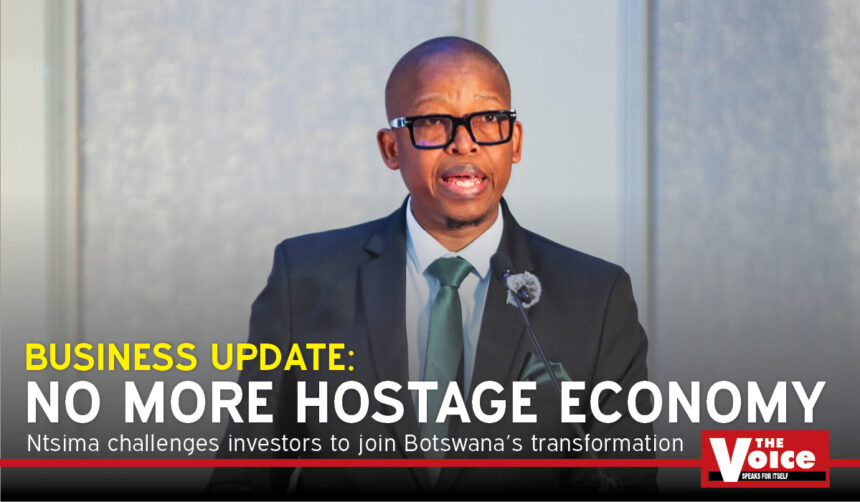
Ntsima challenges investors to join Botswana’s transformation
Botswana has unveiled an ambitious blueprint to fundamentally reshape its economy, signalling a decisive shift away from decades of diamond dependence as government courts investors to help deliver a P40 billion economy by 2036.
Addressing chief executives, investors and policymakers at the inaugural Africa CEO Roundtable in Gaborone on Monday, Minister of Trade and Entrepreneurship Tiroeaone Ntsima declared that the era of relying on a single commodity to sustain national growth must come to an end, describing such an economy as a hostage economy.
His remarks come at a time when Botswana is grappling with weaker diamond sales, slowing economic growth and mounting pressure to create jobs, particularly for the country’s growing youth population.
“For more than five decades, Botswana’s growth story has largely been a diamond story,” Ntsima told delegates.
“That story lifted us from one of the poorest countries on earth to an upper-middle-income nation. But an economy anchored to one resource is not a sovereign economy. It is a hostage economy.”

Ntima further said that the administration of President Duma Boko was elected not to preserve the status quo but to transform the country’s economic structure through aggressive diversification.
“The theme of this roundtable, ‘Towards a P40 billion economy by 2036,’ is not a slogan. It is an instruction,” he said.
Rather than presenting diversification as another policy aspiration, Ntsima outlined six sectors that the government believes will drive Botswana’s next phase of economic expansion. At the top of the agenda is agriculture and agro-processing, where the government wants Botswana to reduce its dependence on imported food while developing industries capable of supplying regional markets.

“We import too much of what we eat,” Ntsima said, arguing that investment in irrigation, financing and value addition could transform Botswana from a net food importer into a regional supplier within the next decade.
Even though mining will remain central to the economy, government wants significantly more value retained within Botswana.
Ntsima said recent amendments to the Mines and Minerals Act send a clear message that Botswana is no longer content exporting raw minerals while processing and manufacturing take place elsewhere.
“We do not intend to remain merely an exporter of unprocessed minerals,” he said. “Botwana wants processing, cutting, refining and manufacturing to happen here.”
The government also wants to position Botswana as a regional investment and trade gateway by leveraging its political stability, investment-grade reputation and strategic access to African markets through the African Continental Free Trade Area.
The digital economy was identified as another major growth frontier, with the government seeking to position Botswana as an active participant in artificial intelligence rather than simply a consumer of imported technologies.

Ntsima said that AI presents opportunities to improve productivity across finance, agriculture, logistics and public administration while creating entirely new industries.
Furthermore tourism is also expected to evolve beyond wildlife, with greater emphasis on business events, conventions, culture and gastronomy as the government seeks to diversify visitor spending.
Energy emerged as perhaps the most urgent investment opportunity. Despite possessing some of Africa’s strongest solar resources, Botswana continues to import a substantial share of its electricity.
Government now wants greater private sector participation in renewable energy generation, battery storage and electricity infrastructure to support industrial expansion while strengthening national energy security.
Recognising that investment follows confidence rather than promises, Ntsima said government is accelerating reforms to reduce the cost and complexity of doing business.
These include improving business registration systems, strengthening investment institutions and implementing the Botswana Economic Transformation Programme to convert policy ambitions into bankable projects.
He also called on institutional investors, pension funds and international financiers to partner with government through blended financing models capable of supporting large-scale infrastructure and industrial development.
“We are asking investors to bring more than capital,” he said. “Bring technology, management expertise and global networks. The P40 billion economy we are building is as much about capability as it is about capital.”
The minister challenged investors to look beyond Botswana’s traditional diamond narrative and assess the country’s emerging opportunities on their commercial merit, insisting that the country’s economic transformation would be driven by sustained partnerships between government and the private sector.
“The next chapter of Botswana will not be written by chance, and it will not be written by government alone. It will be written by builders who choose to place their capital, expertise and confidence in this country.” he said.
Whether the vision translates into reality will depend on the government’s ability to turn policy into implementation and attract the scale of private investment needed to unlock new industries.
For Botswana, the race towards a P40 billion economy will not be won through ambition alone, but through the successful execution of the diversification agenda now being placed before investors.