



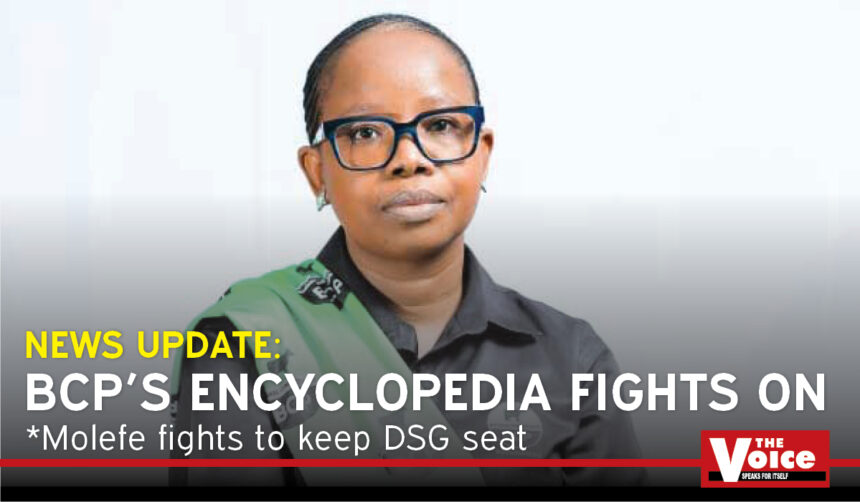
*Molefe fights to keep DSG seat
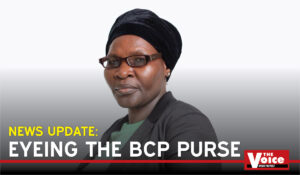
It is often said that politics breaks most women, especially young ones, but Tebogo Molefe is a different story altogether.
The Botswana Congress Party (BCP)’s Deputy Secretary General has survived many internal battles, coalition drama and tough opposition politics to become one of the most experienced leaders in the party.
She has served as Youth League President, BCP Women’s League Chair and is now defending a position she has held for five years.
Having earned the respect and admiration of her comrades over the years, Molefe is also fondly known by her nickname ‘The Encyclopedia of the BCP’.
The Voice staffer, DANIEL CHIDA spoke to her as she prepares for the coming congress, running under ‘Team Taolo’.

Welcome back. You are defending your seat, why do you prefer the DSG position?
The DSG position sits at the operational and strategic heart of the BCP. It requires resilience, institutional memory, and a deep understanding of our structures across Botswana. I am defending this seat because continuity matters. As we head towards 2029, we are competing against a new government that will fight aggressively to retain power. The BCP needs stable, tested leadership that understands both the internal organizational terrain and the external political landscape.
What’s your strategy to hold it, especially with new members also running?
Democracy is the lifeblood of the BCP, and I respect every comrade contesting leadership. However, leadership must be assessed against performance and context. When we took over in 2021, we inherited an incredibly turbulent environment, including major coalition disruptions and difficult but necessary disciplinary decisions. After the 2019 coalition limited us to only 20 constituencies, we had to rebuild our independent identity from scratch, which severely impacted our visibility especially in the south. Despite these financial and political hurdles, we reorganized, rebranded, and contested independently in 2024. Today, the BCP proudly stands as the official opposition with 15 MPs and 125 councillors. My strategy is simple: account honestly for this track record, present a clear roadmap for 2029, and ask members to judge leadership based on proven performance under pressure.
What goals have you achieved since your election?
Our greatest achievement was stabilizing and rebuilding the party during one of the most volatile chapters in its history. We preserved organizational cohesion, restored confidence in the BCP brand, and successfully repositioned the party as a premier national force. Moving from coalition uncertainty to becoming the Official Opposition with 15 MPs and 125 councillors didn’t happen by accident. It was the product of sacrifice, rigorous teamwork, and absolute organizational discipline.

What remains unfinished?
The work of building a governing party is never complete. We have successfully stabilized the ship, now we must prepare to govern. Our focus moving forward is shifting from opposition politics to building a credible government-in-waiting. This means strengthening our grassroots structures, increasing constitutional literacy within the party, securing financial sustainability, and modernizing our campaign systems so the BCP is ready to lead Botswana responsibly from day one.
What policies or rules you changed to make the BCP more gender inclusive?
I believe true inclusivity is about creating real capability, fair opportunities, and a level playing field where women can contest, win, and lead with confidence. Leadership must always be earned through competence and hard work, and our role is to ensure the doors are wide open.
The BCP has a solid affirmative action framework, including a 30% representation quota in leadership structures. What is incredibly encouraging is that within our current lobby team, women actually make up 42% of those contesting for leadership. This demonstrates that our women aren’t just looking for symbolic representation; they have the confidence, competence, and drive to compete and lead on merit.
As a woman, which issues will you focus on more this time?
My focus is entirely on results, organizational discipline, and delivery. Politics is intensely competitive, and women in leadership often face higher levels of scrutiny. I learned early on to rely on performance rather than expectations of automatic support. Over time, people may debate personalities, but they cannot ignore results. I am focusing on building an efficient, high-performing party machine.
Explain your role as DSG and how it differs from the SG.
The SG is the chief administrator of the party, while the DSG directly supports that office in executing and coordinating day-to-day organizational operations. In the absence of the SG, the DSG steps in to ensure seamless continuity. Because the Secretariat is the operational engine of the party, it naturally absorbs the pressure and frustrations of the entire organization even on matters outside our constitutional mandate. That is why a key priority moving forward is driving constitutional literacy across all structures, ensuring role clarity while maintaining the resilience required to keep the party focused on the bigger mission.
What was the biggest resistance you faced when you became the first female BCP Youth League President? And how did you overcome it?
The biggest hurdles were traditional perceptions about young women in political leadership. In politics, women are often expected to continuously prove their capability before being fully accepted. I quickly realized that support is never automatic from any quarter, but I refused to let that discourage me. I stayed disciplined, focused entirely on grassroots mobilization, and let my performance speak for itself. Delivering results is the ultimate way to dismantle bias.
What advice would you give to a young woman in opposition politics who is told, ‘It’s not her turn’?
My advice is simple: master your party constitution, understand public policy, build your grassroots credibility, and work exceptionally hard. Politics is competitive by nature. Do not wait for permission or rely on identity alone, build an unassailable track record of service, competence, and resilience. Leadership demands sacrifice and invites criticism, but if you are prepared, never let anyone tell you it is not your turn.

Some argue that women’s leagues in opposition parties are sidelined. Has the BCP overcome that?
Within the BCP, women are structurally integrated into the highest echelons of decision-making. Our inclusion is not decorative or symbolic; it is constitutionally protected. The President of the Women’s League sits directly on both the Central Committee and the Executive Committee, where every major political and strategic decision is made. While there is always room to deepen participation and empower more women at the grassroots level, the BCP has built a genuine framework for women to drive the party’s agenda.
What is the one issue where the ruling party is most vulnerable right now?
Their biggest vulnerability is the steep gap between high public expectations and harsh economic realities. The electorate expects swift, tangible improvements in job creation, service delivery, and the cost of living. Transitioning from populist campaign promises to practical, institutional delivery is incredibly difficult, and that pressure point is exactly where the opposition can present a superior, highly practical alternative.
Why hasn’t BCP capitalised on it more effectively?
First, we must acknowledge that opposition politics does not take place on a level playing field regarding resources or media access. Second, the period between 2021 and 2024 required an intense, inward-looking effort to stabilize the party, secure our independence, and rebuild the BCP brand nationally after years under coalition restrictions. It was a necessary phase of strategic consolidation. Now that we have established ourselves as the Official Opposition, we are moving past mere stabilization. We are actively converting our structures into a strategically coordinated, financially sustainable, and high-performing government-in-waiting.
If you could change one electoral law to level the playing field, what would it be?
I would mandate the strict, transparent implementation of public political party funding. A robust democracy requires fair competition. Opposition parties should not have to vie for state leadership under severe institutional and financial disadvantages while the ruling party enjoys the massive benefits of state incumbency. Equitable funding safeguards democracy itself.
What’s a decision you made as DSG that was unpopular but turned out to be right?
True leadership means prioritizing the long-term integrity of the organization over temporary popularity. Some of the difficult moments involved issues of discipline, organizational order, and insisting that structures operate within the constitution during periods of instability and internal tensions. At the time, some people felt certain approaches were too firm or uncomfortable, especially in chaotic environments where emotions and factions were involved. Furthermore, I have never believed that being a loyal leader means being a ‘yes-person’ to senior leadership. Strong organizations require leaders who can respectfully bring hard truths to the table. Looking back, maintaining that firm, principled stand on discipline and constitutionalism is exactly what preserved the stability and cohesion we enjoy today.
When you’re on the campaign trail, what question from a voter stops you cold?
The conversations that pull you up short are never about abstract political theories; they are about basic daily survival. When ordinary Batswana ask how we intend to handle the rising cost of living, youth unemployment, or the devastating impact of Foot and Mouth Disease on our farming communities, it hits hard. Botswana’s rural economy relies heavily on cattle. When a farmer cannot sell livestock, the financial shockwaves tear through local butcheries, transport workers, and entire families. These moments are deeply humbling. People don’t want empty political slogans; they want honesty, empathy, and viable solutions. It reinforces that our march to 2029 isn’t just about winning an election; it is about the immense responsibility of restoring economic dignity to our people.
What are the biggest challenges you are facing this time?
The primary challenge is balancing massive external expectations with the realities of the operational context we managed. Because the Secretariat sits at the engine room of the BCP, the SG and DSG naturally become the lightning rods for internal organizational frustrations even on matters outside our constitutional mandate. It requires a thick skin and immense resilience. Additionally, this internal election is a critical turning point. We are no longer just maintaining an opposition party; we are fine-tuning a machine to take state power in 2029 against an incumbent government. Balancing continuity and institutional stability with the necessary internal renewal for a tougher national fight is our main challenge, but the battlefield trials of the last four years have made us thoroughly ready for it.