

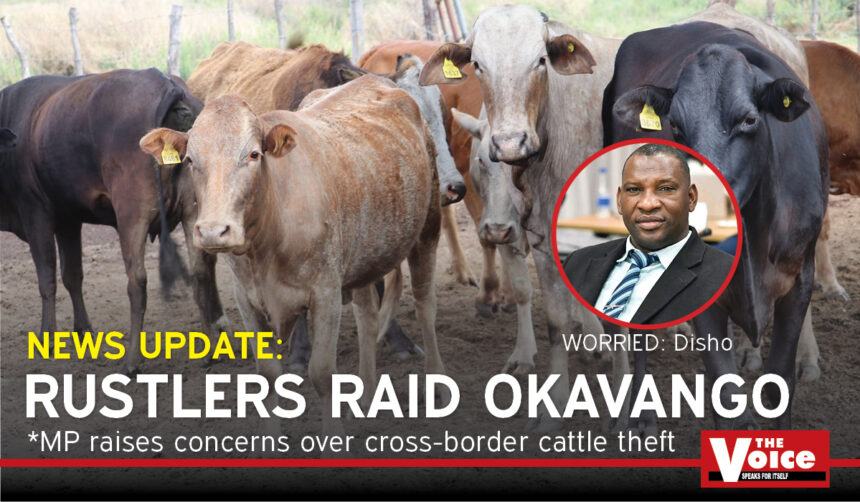
Rustlers raid Okavango
Cross-border livestock theft along the Okavango corridor has escalated into a full-scale crisis for farming communities in northwestern Botswana.
While joint security efforts this week intercepted 17 stolen cattle in Namibia’s Zambezi Region, local authorities warn that organised syndicates are stripping rural families of their entire livelihoods.
Reports from Namibia indicates that the Namibian Police Force (NamPol) intercepted 12 herd of cattle carrying official Botswana brand marks in the Kongola Constituency, between Masambo and Omega 3, alongside five others recovered near Omega 2 on Monday this week.
The operation is said to have exposed a well-traveled smuggling route where rustlers drive stolen livestock across the border through Namibia en route to Angola and Zambia.
For Okavango East Member of Parliament, Gabotsholwe Disho, a single interception, while welcome, barely scratches the surface of a systemic disaster pushing local communities to the brink.
“It is true. Cattle are being stolen every week, every day in Okavango East,” Disho stated in an interview this week.
“The problem has been persisting for the past five years, but this year it has escalated so much that farmers are now moving their cattle to Okavango West, across the river, to save them from cattle rustlers,” Disho sated and added, “It is quite a problem as many farmers have been left with nothing. When the rustlers come in and find a kraal with 40 or more cattle, they take them all. In the recent 51 that was brought back earlier this month, about 20 of those cattle belonged to a single farmer.”
Disho highlighted that the raids are not opportunistic local thefts, but coordinated operations by highly organized syndicates that strategically target villages across the region to stretch police resources to their limit.
The porous frontier makes these operations seamless. “The border fence was destroyed many years ago by wildlife, so it’s a free crossing of imaginary borders,” Disho explained.

Once stolen, herds are driven toward Angola via the 25-kilometer Caprivi Strip corridor or funneled into illicit markets in Zambia.
Disho’s concerns are backed by official government data. In a formal response to parliamentary inquiries raised by Disho, Minister for State President, Defence and Security, Moeti Mohwasa, revealed that more than 350 cattle were rustled across the border along the Okavango East stretch between 2022 and 2025.
THE FMD POLICY
A major point of friction for affected communities is the post-recovery handling of livestock under veterinary biosecurity laws. When stolen animals cross international boundaries, veterinary authorities often invoke mandatory culling procedures to guard against Foot and Mouth Disease (FMD).
Disho argues that applying strict culling protocols to recovered herds in this region defies practical reality and inflicts double financial ruin on victims:
“The sad thing is, on return, the veterinary officers will want to kill them and compensate a farmer with P700 per head, and it does not make sense,” Disho argued. “Alternatively, they could take them directly to the abattoir. Our region is in a Foot and Mouth red zone anyways and we do sell to the abattoir.”
For farmers who lose tens of thousands of Pula worth of prime breeding stock, a P700 government payout per head provides virtually no relief after surviving a syndicate raid.

While NamPol’s recent recoveries brought back over 50 head of cattle between February and July 2026, security agencies acknowledge that permanent border surveillance remains exceptionally difficult to maintain.
Vast, uninhabited terrain, poor cellular network coverage, and a shortage of patrol vehicles hamper continuous policing along the Kavango and Zambezi corridors.
As local farmers continue fleeing across the river to shield what remains of their livestock, leaders in both Botswana and Namibia are calling for urgent border fence repairs and reinforced cross-border intelligence sharing to stop the syndicates before rural livelihoods are completely wiped out.