



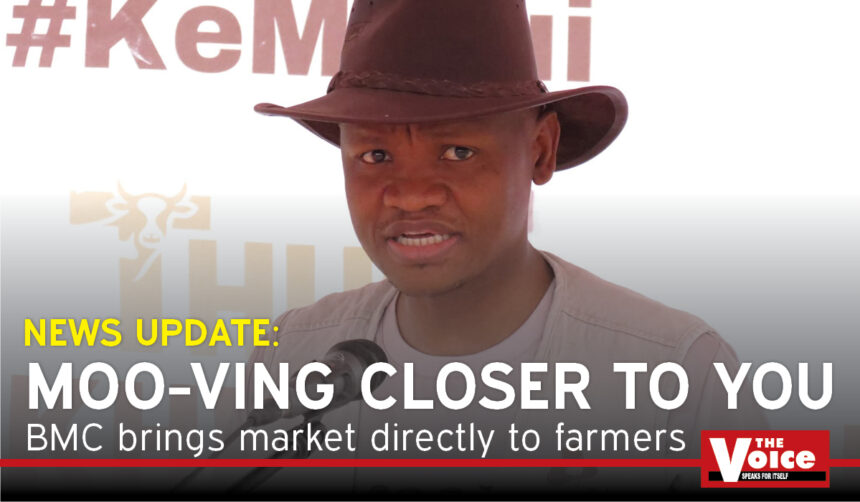
BMC brings market directly to farmers
Botswana Meat Commission (BMC) officially launched its Direct Cattle Purchase (DCP) Scheme in Makalamabedi village this week, a move aimed at unlocking the full potential of cattle farming in Ngamiland and Okavango regions.
Promising things will be done differently from now on, acting Minister of Lands and Agriculture, Edwin Dikoloti, directly addressed the long-standing grievances of Ngamiland farmers.
“For too long, farmers in Ngamiland have felt marginalised, unable to benefit from BMC. You have told us, ‘We are ready to trade, but the system does not see us,’ ‘Why is BMC Maun not working for us?’” he said.
Dikoloti is confident the new DCP Scheme is the answer.
Designed to bring the market directly to the farmer, creating a faster, transparent and reliable platform for cattle sales, the initiative is expected to improve farmers’ incomes, relieve them of the burdens of quarantine.

In the past, farmers in the region had to take their cattle to BMC in Maun, incurring transportation and quarantine costs, which greatly reduced their profits.
With DCP, this will be a problem of the past.
Despite challenges like climate change and a significant decline in herd size, down from a historical 317, 000 to about 228, 000 head of cattle, the Minister praised the farmers’ perseverance.

He noted their significant investments in breeding have resulted in a high-quality herd that surpasses many other districts.
BMC figures attest to this quality.
Ngamiland’s top 10 animals recently fetched impressive prices ranging from P12, 200 to P13, 700, with Cold Dressed Mass (CDM) hovering around 394kg.
The DCP program focuses on animal health to reduce reproductive losses, increase compliance, promote quality assurance and provide access to high-value markets.
Foot-and-Mouth Disease (FMD) was acknowledged as a persistent economic challenge.
Although Dikoloti expressed confidence in overcoming it through the renowned cooperation of Ngami/Okavango farmers, he stressed the need for more.

“We must collectively invest in upholding international standards including traceability and quality assurance, create opportunities and seize them as they emerge,” he urged.
In an effort to strengthen the sector’s resilience, government has introduced several initiatives guided by the revised National Agricultural Policy (2025-2030), such as the Integrated FMD Official Control Program.
This includes risk-based vaccination, vaccine monitoring and the establishment of a protection zone and commodity-based trade (CBT).
Herding for Health is a collaborative approach that manages grazing, provides veterinary services, and connects farmers to markets while conserving biodiversity and complementing CBT by providing equivalence to quarantine.
The Minister clarified that the BMC abattoir in Maun is now viewed strategically as an FMD control installation rather than a profit-oriented entity.
Furthermore, two government-financed mega projects – a Meat Value Addition and Secondary Processing Plant (P230 million) and the revitalisation of the tannery (P225 million) – are underway to restore BMC’s profitability and ultimately improve farmer returns.
A key new component is A-Di-Tsale, an extension support program that will deliver essential livestock health and reproductive services through the private sector.
The Minister said this program will, for the first time, provide an ordinary farmer in remote areas like Matsaudi, Seronga or Motopi with access to quality veterinary healthcare that was previously limited to a privileged few.
To maximise benefits from the DCP and A-Di-Tsale, farmers were advised to organise into groups such as clusters and syndicates, which will be prioritised in the program.
They were equally encouraged to invest in on-farm Artificial Insemination (AI) to take advantage of the highly subsidised bull semen supplied by the government, including semen from imported bulls, now available at P75 per straw.
Dikoloti concluded by affirming the Ngamiland/Okavango region as being uniquely placed to be at the forefront of this agricultural revolution, possessing great stockmen with unmatched passion, and a land with superior livestock genetics.