



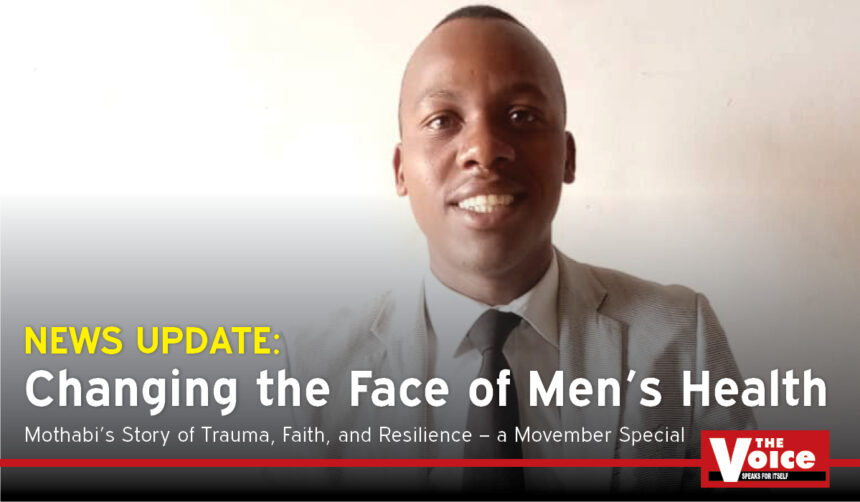
Mothabi’s Story of Trauma, Faith, and Resilience – a Movember Special
LOCALLY, countless children have lost their mothers to gender-based violence (GBV), the effects of which include a range of mental health challenges such as depression, anxiety, post-traumatic stress disorder (PTSD),
and suicidal ideation.
This two-part feature highlights one such story, turning the spotlight on the mental health dimension of ‘Movember’ (a portmanteau of moustache and November).
With its origins dating back to 1999 in Australia, the land down under, this annual event has grown into a global movement. Its primary goal, according to the Movember Foundation, is to “change the face of men’s health.” Each year, men are encouraged to grow moustaches to spark conversations and raise funds for critical men’s health issues, particularly mental health and suicide prevention, as well as prostate and testicular cancer.
Coincidentally, currently in neighbouring South Africa, Women for Change South Africa, a leading pressure group against GBV, is planning a national Women’s Shutdown on November 21 st ahead of the G20 Summit.
The movement is calling on the government to declare GBV and femicide a national disaster.We stand in solidarity with our neighbours, as the global 16 Days of Activism Against Gender-Based Violence draws near.

To that end, Voice Woman sits down with Tanyala Mothabi, the 27-year-old owner of Mogoditshane-based MZ Car Imports, who endured unimaginable loss at just 12 years old when his mother was killed in a brutal act of GBV perpetrated by her partner.
“One day, I arrived home from school to find my aunt wailing. I instinctively knew something was terribly wrong, and quickly learnt that my mother’s boyfriend had sent a chilling text: ‘I killed your sister, and Mothabi is the only one who knows where I stay’,” he reflects somberly, and continues, “We rushed to Kutlwano Police Station to report the matter, and the police took us to the scene in Block 7, near our home in Block 1, Francistown.”
The perpetrator, who had been in a relationship with Mothabi’s mother, Sakhile, for over a year, kept texting throughout the day.

“He was communicating with my aunt, claiming he loved my mother deeply and asking my aunt to take care of us. It was shocking because he had seemed like a normal, cool guy whom one wouldn’t have thought was capable of committing such a heinous crime. I remember we’d eaten out together once and at his place. I think they’d had a misunderstanding,” he recounts, adding he struggles to replay the emotions he went through that dreadful day back in 2010.
“When we arrived at the house, we discovered the door was locked…” he pauses, drawing in a deep, heavy breath.
“The police then peeped through the window and reported that they could see clearly the legs of a woman lying down of the floor. They then went ahead and forced open the door.”
Immediately upon seeing his mother’s legs, Mothabi screamed. “I knew it was over… that my beloved mother was no more. Then, she was placed into a white body bag before being carried away. I was then taken to the police office to record a statement. I don’t know where I got the courage, everything was just a blur,” he narrates, adding, “I believe the story made The Voice Newspaper front page news – sometime in the month of August. I think she was stabbed with a screwdriver. Thus, she died from internal bleeding… at just 32 years of age.”
According to Mothabi, they later learned that the murderer had taken his own life at the end of that tragic day. “He ended his life in a goat’s kraal at his cattle post,” he recalls.
At the time, Mothabi, a middle child, was the only one of his siblings who was present. “My younger brother was only five years old. Until last year, he never really knew what had happened. Meanwhile, my elder brother only found out later that day when he arrived home from school. This experience has affected us psychologically. When my brother was in Form 3, we were separated because I had moved to Gaborone for tertiary studies, while my older brother was pursuing pastoral training. That separation was another heavy blow, as it prevented us from bonding and processing our tragedy together,” he explains.

Still, Mothabi expresses gratitude to God for how far his family has come. “My younger brother is now in his third year studying Mathematics at the University of Botswana. Thankfully, his karate training became a much-needed outlet; it teaches discipline. I’m glad he’s very focused and doing well academically. He’s also a Christian.”
Mothabi says he only truly began to heal last year. “I realised I was carrying a lot of unforgiveness, internalised anger and resentment. I had neither forgiven my mother nor the man. I had never really faced the pain and trauma; it was my own way of coping. But I turned to God for help, and only then did the psychological scars begin to heal. God, alone, understood my struggle. Building an intimate relationship with Him not only lifted the pain but brought light into every area of my life,” he declares, adding that he believes his loss happened for a reason. “I’m a stronger person today because of it.”
Mothabi says his late mother was independent to a fault. “I remember being in Standard 3 and never once feeling that we lacked anything. As a single mother raising three sons in a one-room house, she worked tirelessly in the construction industry, yet always ensured we had everything we needed. She taught me that the circumstances into which one is born should never dictate the life one leads,” Mothabi recalls fondly.
Though the youngest in her family, Mothabi remembers that his devoted mother commanded respect from her siblings due to her assertiveness, “…a quality I see in myself today,” he notes and continues, “She was my inspiration. Though she wasn’t highly educated, her optimism and belief in life shaped me into the bright student I was at school. Much of what I achieved academically and personally is, in many ways, because of her.”
Growing up without a father, Mothabi says he never felt the absence. “I never pursued the matter,” he says.
“The little information I got from my aunts and uncles was vague, and honestly, I just lost interest. My focus was on building a life my mother had shown me was possible, hence after graduating from tertiary, I went into self employment.”
However, that initial foray into the business world did not begin smoothly… Find out how next week, as Mothabi will reflect on the inherent challenges of entrepreneurship, particularly within the unforgiving car import industry.
A double whammy, the young trader suffered a major blow to his reputation a few years back after encountering unforeseen pitfalls that ultimately landed him in prison. Not one to be defeated by adversity – a trait he says he inherited from his late mother – the resilient and God-fearing young man believes that low point drew him closer to his Creator.