




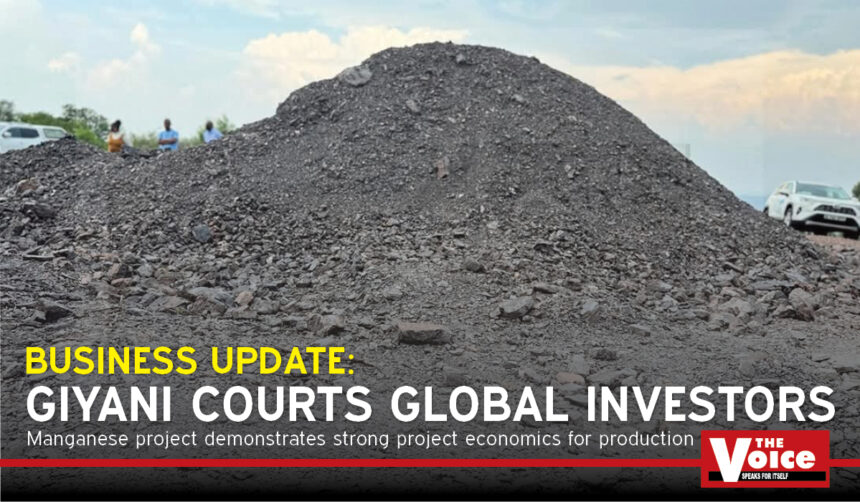
Manganese project demonstrates strong project economics for production
Giyani Metals has described its proposed $535 million manganese project in Botswana as economically viable ahead of talks with strategic partners.
Giyani Metals is looking for partnerships for the K.Hill project which is expected to generate net free cash flow of $1.6 billion over its 25 year life of mine, requiring $679m in total life of mine capex, as according to feasibility studies.
The K.Hill Project has been scoped to produce high-purity manganese sulphate monohydrate (HPMSM), a battery grade mineral used in electric car manufacturing, from its site near Kanye in Kgwakgwe Hill.
“We will be progressing our discussions with strategic partners and evaluating opportunities within the battery-grade manganese sector that have the potential to enhance value for our shareholders,” said Giyani Metals interim executive chair Nigel Robinson. HPMSM production has strategic value as China controls about 95% of the market.
South Africa’s Industrial Development Corporation has provided $16m in debt finance to Giyani Metals whilst more recently Patrice Motsepe’s African Rainbow Minerals has invested in the company, providing equity finance and a royalty agreement worth 19.99 percent of the firm through its ARCH Emerging Markets Partners.

There has also been some interest in Giyani’s plans from the US.
A letter of intent for potential finance of $225m was issued by Export-Import Bank of the US.
Giyani Metals is planning first production in 2029, a move away from a previous plan for 2025 production.

By this time, battery grade manganese will have entered its first year of supply deficit after which there were will be average deficit growth of 12%, according to a Giyani Metal’s presentation.
“With China controlling 95% of manganese processing capacity, access to non-China supply of this critical material is constrained. The Definitive Feasibility Study marks a significant step towards a viable solution,” said Robinson.
Meanwhile a feasibility study for Giyani Metals K.Hill open pit manganese project outlines a much costlier operation and with lower value than in a previous economic study, though it’s now backed with proven reserves.
At an 8% discount rate, the study gives K.Hill a post-tax net present value of $481.5 million, half of the value estimated in the 2023 preliminary economic assessment (PEA), Giyani reported Thursday.
Initial capital costs rose 88% to $535 million, the internal rate of return fell by 9 percentage points to 20% and manganese production is down 57% to 1.5 million tonnes. The mine life is also cut by more than half to 25 years.
“These results endorse K.Hill as a unique, mine to-market battery-grade supplier of manganese to meet growing Western demand, and provide a solid foundation for further optimization and continued development of the project. Building on the successful production of both high-purity manganese oxide (HPMO) and high-purity manganese sulphate monohydrate (HPMSM) from our demonstration plant in Johannesburg, we are now well-positioned to meet the evolving requirements of the battery and energy storage markets.” said Robinson.

Manganese, a key ingredient in steelmaking and increasingly valued in the form of HPMSM for electric vehicle batteries, is mined mainly in countries such as South Africa, Australia and Gabon, while China dominates battery-grade manganese processing. Few Western countries produce manganese in significant quantities outside Australia and, to a lesser extent, Brazil.
The feasibility study upgraded the deposit over the 2023 preliminary economic assessment.
It estimates that K. Hill hosts proven and probable reserves of 5.3 million tonnes grading 12% manganese oxide for about 642,000 tonnes of contained metal.
Construction of the mine at K. Hill could start in early 2027, with commissioning in late 2028 and process plant ramp-up in 2029, the study shows.