


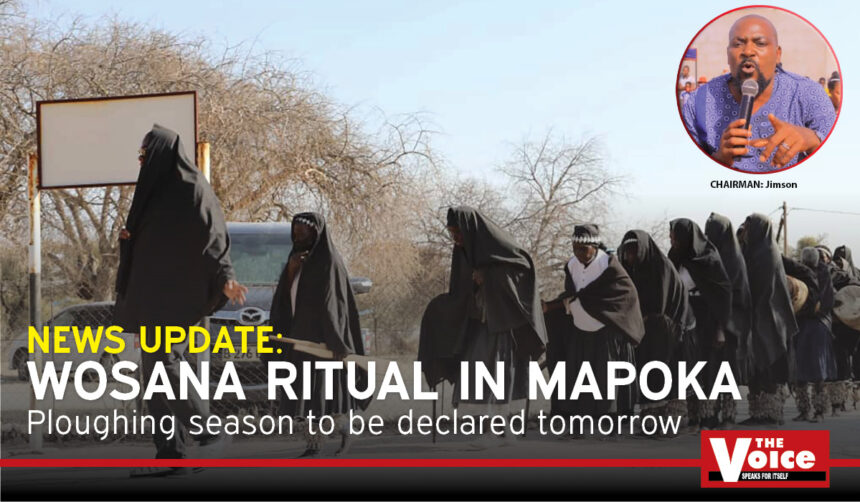
Ploughing season to be declared tomorrow
WOSANA Association practitioners in Botswana will converge at the Mapoka Customary Court on Friday morning for the declaration of the start of the ploughing season.
The formal announcement, traditionally made by a tribal leader (kgosi), marks the opening of the agricultural year and permits community members to begin working on their fields. It is one of four important events on the Wosana calendar.
According to the association’s chairperson, Richard Bantolo Jimson, the first important event is the ‘sound of the first drum’ (pulomeropa), which takes place in July.
“This is where we go out to pray for rain, and after praying for rain, our second event is to bless the seeds and hand them to the kgosi to declare the ploughing season,” he said.
Jimson said the third event is the closing of the drums in October, followed by the final event, the biting of the first harvest (go loma), in March.

Wosana Ritual and its associated practices are among the oldest rainmaking rituals observed by Ikalanga communities in the North East.
The association was officially recognised by UNESCO (United Nations Educational, Scientific and Cultural Organization) with the presentation of an inscription certificate at the Mapoka village kgotla last year.
The event drew Wosana practitioners from across the Northeast region. Wosana was added to UNESCO’s List of Intangible Cultural Heritage in Need of Urgent Safeguarding in 2024, following research that was first undertaken in 2013.

The ritual is practiced not only in the Northeast but also in parts of Central Botswana and in some Zimbabwean villages along the Botswana border.
In its decision to safeguard Wosana, UNESCO noted that the advent of Christianity had led to a significant decline in the observance of the ritual. Many traditional leaders have converted to Christianity and no longer recognise ancestral worship.
Wosana’s inscription became the fourth for Botswana, following the Earthenware Pottery-Making Skills of the BakgatlabagaKgafela, Dikopelo folk music, and Seperu folk dance and associated practices.
In an interview with The Voice, Jimson reiterated that there was growing concern over the dwindling number of practitioners.
“Our main concern is that we don’t see young people answering this calling. Madumbavula (those who make rain)—only the elders are still hanging on, and one of the leading elders has now gone blind,” he said.
“This is a concern because for any tradition and culture to survive, it needs young people to carry it forward,” he said.