



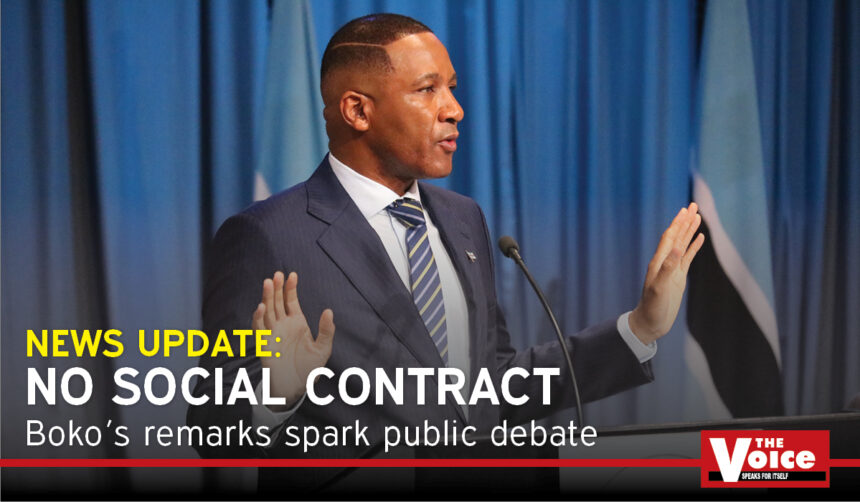
Boko’s remarks spark public debate
President Advocate Duma Boko’s declaration that the Umbrella For Democratic Change (UDC) does not have a “social contract” with the nation to deliver on its manifesto promises, has sparked public debate.
Among the promises UDC made during the election campaign were a P1,800 monthly pension for the elderly, a P2,500 allowance for tertiary students, a P4,000 minimum wage, and the creation of 100,000 jobs within the first 12 months of government.
Other pledges included free English breakfast in schools and a P300 grant for newborn infants.
Nearly fourteen months after the new government assumed power, progress appears slow in the eyes of some Batswana, while others believe the UDC still needs time to settle and steer the country in a new direction.
President Boko’s assertion that opposition politicians are wrong to believe there is a social contract between the ruling party and voters, however, appears to have struck a raw nerve.
His remarks have triggered intense debate on social media platforms and radio talk-shows and many are beginning to question the trustworthiness of politicians.
The international media has also picked up on the comments and some are treating them with ridicule.
In the social media debates, some commentators have argued that the former ruling party Botswana Democratic Party (BDP) did the same, and never delivered on many of its promises and therefore the UDC President should not be singled out.
Others warn that the UDC should be more cautious and not repeat BDP mistakes since they are faced with a nation that has experioenced the removal of a government.
Political commentator Keaoleboga Dipogiso believes political parties should develop the social contract immediately upon assuming office.
“Thus, they should transform their manifesto promises into government policy to enable ease of implementation. It is government policy and not manifesto ideas that build a social contract. If manifesto ideas are not adopted by government, they remain qualitative ideas and they are unlikely to be implemented,” Dipogiso said.
The former lecturer at the University of Botswana added that the UDC should scrutinize all its ideas in the manifesto, pick the best and priotitise them for implementation looking at the resources at its disposal.
He warned that the President’s remarks may be interpreted differently by different voters, but the remarks give the opposition a strong voice against him and his government, and may promote voter apathy that is already a big challenge especially among the youth population.
“It may drive some away from the voting stations, as it may sound like he was giving them a middle finger. For me, he was correct when he said manifesto ideas aren’t a social contract. He was correct also when he added that the factors that influence voting decisions are various. What I doubt however, was the political correctness of such remarks as it threw his followers and voters into confusion,” Dipogiso observed.
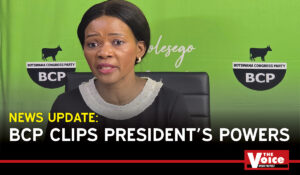
The Botswana Congress Party (BCP) has already responded to Boko’s remarks in a press conference that they addressed on Monday saying the President is ‘lost’ and has no clue where he wants to take this country.
Professor Zibani Maunderni of the University of Botswana Political Sciences conceded that promises made in the campaign manifesto are not a contract, but since the UDC has assumed state power they have the opportunity and power to translate such into government policies. He said that the voter made their decisions based on what the main political parties pledged in their manifestos, and majority believed in what the UDC presented to them.
He added the ruling party seems to be confused about what needs their urgent attention at this moment, citing the economy and the public healthcare sector and not the Constitutional Court and other sectors where there is no crisis.
“Their performance on the economy is disappointing and we were expecting to be doing well this time and not to hear that the government is likely to run out of cash in a few months time. Even the public healthcare sector is in a crisis and needs urgent attention. They should be prioritising on those,” he said.
Maundeni said that the government is giving priority to wrong issues.