

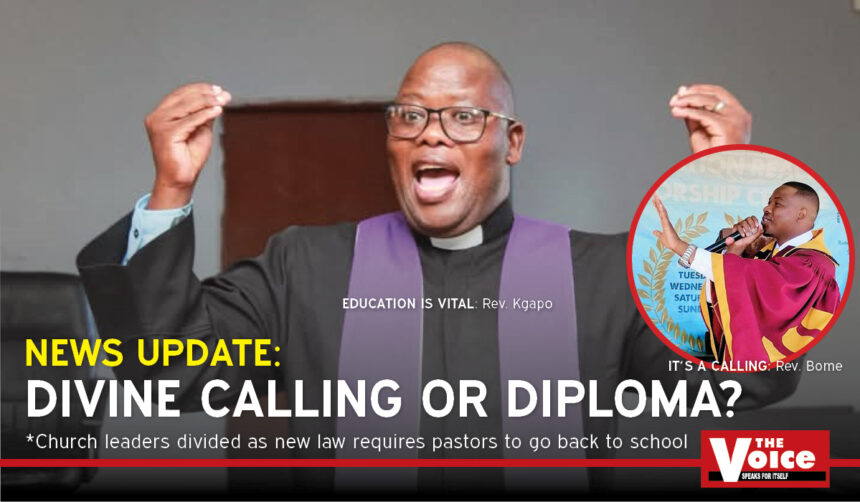
*Church leaders divided as new law requires pastors to go back to school
A storm is brewing in Botswana’s religious and political landscape following renewed debate over a controversial law requiring church leaders to hold formal theological qualifications.
The heated discussion resurfaced in Parliament recently, where some Members of Parliament called for a review of the Registry of Societies Act of 2022, a law that requires pastors, prophets and other religious leaders to possess at least a Diploma in Theology from a recognised institution.
The legislation, introduced through amendments to the Societies Act by former Minister of Labour and Home Affairs, Annah Mokgethi, was aimed at curbing the growing of churches, addressing the commercialisation of religion, and preventing financial abuse.
Giving a briefing after the parliamentary debate, current Minister of Labour and Home Affairs, Major General Pius Mokgware, defended the law, stating that it also seeks to tackle anti-money laundering and counter-terrorism financing concerns.

He further indicated that existing pastors who do not meet the requirements may be given an opportunity to upgrade their qualifications.
However, the issue has exploded across social media, drawing strong and often opposing reactions from religious leaders.
Bishop Kitso Bome of The Well of Life Church of God warned the Umbrella for Democratic Change (UDC) to tread carefully on the matter. He argued that the law risks replacing divine calling with academic credentials.
“A law may require a diploma, but heaven requires a calling,” Bome said.

“Since when did government decide who God can use? The apostles were ‘unlearned men,’ yet they shook nations because they had been with God.”
Quoting the scripture, Bome referenced Acts 4:13 and Acts 5:29 to emphasise obedience to God over man-made laws. He maintained that while authority must be respected, it should never override spiritual mandate.
“A system can regulate institutions, but it must never regulate the anointing,” he added.
“If a law begins to limit who can preach and who can answer God’s call, it becomes spiritual interference. The Church is not governed by certificates, but by the Holy Spirit.”
But not all voices in the religious community share Bome’s concerns.
Professor Raphael Habibo of the Assemblies of God expressed support for the requirement, saying theological education should be encouraged among church leaders.

“I don’t see any problem with that. We should be encouraging our pastors to study theology,” he said.
“The only issue is linking it to money laundering. Financial misconduct can happen to anyone, educated or not.”
Habibo added that theological training is essential for proper interpretation of the scripture and effective church administration in a modern, complex world.
Echoing similar sentiments, Reverend Mokgweetsi Kgapo of UCCSA James Good Memorial stressed the importance of equipping pastors with relevant skills, particularly in an era shaped by technology and evolving societal challenges.
However, Kgapo raised concern over what he described as a lack of consultation by government before implementing the law.
“Consultations are important,” he said. “We have established structures such as the Botswana Council of Churches, the Evangelical Fellowship of Botswana and the Organisation of African Independent Churches. These bodies should have been engaged.”