



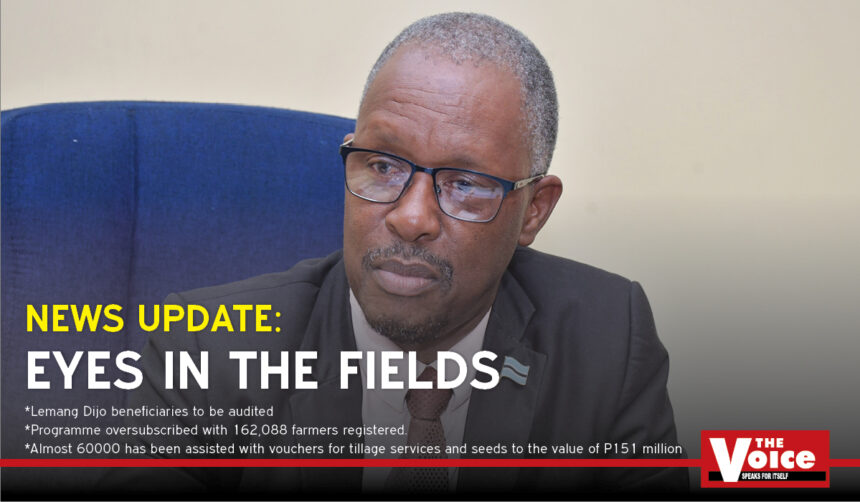
*Lemang Dijo beneficiaries to be audited
*Programme oversubscribed with 162,088 farmers registered.
*Almost 60000 has been assisted with vouchers for tillage services and seeds to the value of P151 million
As the Ministry of Lands and Agriculture fine-tunes its grant subsidy programmes, the flagship Lemang Dijo programme has announced plans to audit beneficiary farmers to verify that the data they submit matches the reality in their fields.
Programme coordinator Oratile Monthe this week revealed to Voice Money that, in a bid to clamp down on potential misuse of state funds, all grant beneficiaries will be subject to the audit.
“We are going to audit all the farms of the grant beneficiaries and we expect the process to help us determine what is happening on the ground,” Monthe said, noting that beneficiaries will be required to fill up a farm journal.
“It is just a diary which outlines all the timelines for all the farming activities. That helps us to have an idea and confirmation that indeed the farmer has ploughed and planted, but if you say you have planted and we should pay tractor owners but three weeks pass without any activity reflecting on the journal, that becomes a red flag. We start keeping any eye on you and you become a candidate for audit,” said Monthe urging farmers to comply with the guidelines of the programme.
Lemang Dijo which was rolled out during the current ploughing season is a revised arable small-scale programme that provides subsidy for tillage and pesticides for up to one hectare, delivered via an e-voucher worth P4,400.

Alongside the government-supplied fertiliser, the package also includes seeds, mechanical help, threshing and shelling, extension services, and support for beehives capped at one colony.
Although the programme initially targeted 50 000 farmers this season with a budget of P220 million, demand has far exceeded expectations.
By January 12, 2026, a total of 162,088 farmers had registered with 126,482 having verified fields and actively engaged in grain production.

Among these, 93,649 are farm owners while 51,376 operate on leased land.
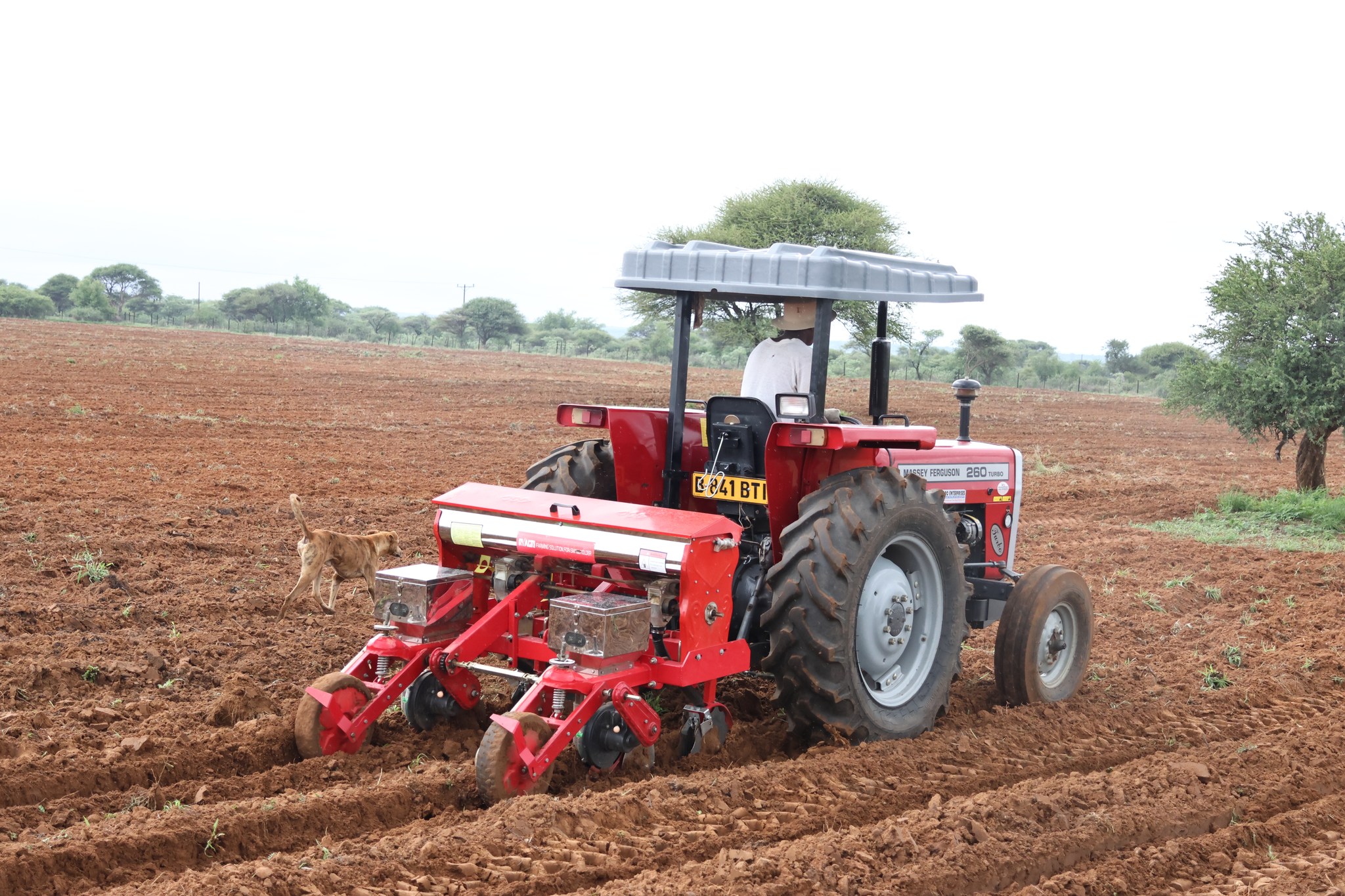
A total of 59,555 farmers have been issued with e-vouchers and are actively procuring seeds and tillage services, covering 59,546.35 hectares with a total value of P151.5 million. Of this amount, P95.6 million is allocated to tillage subsidies, P23.8 million to seeds, and P17.3 million to pesticides.
Of the grants issued, 31,821 were issued to farm owners while 27,734 were issued to farmers under lease.
To date, farmers have purchased seeds valued at P19.7 million, pesticides valued at P637, 440 and tillage services valued at P4.5 million for 5,928.5 hectares.
“Last year we had 72,000 farmers from the previous programme because we noticed structural defects which needed solutions. People were sub-leasing land and using micro scale farmers to plough a lot of land which inflated numbers,” Monthe said.
This season, government capped grants to a maximum of five hectares per ploughing field, to curb abuse.

“One farm can’t get more than five hectares under the programme,” Monthe noted, adding that this does not stop people from leasing land to more than five individuals. “But it means we will conduct due diligence to confirm that those people exist and have genuinely ploughed”
Monthe further explained that while registrations have exceeded targets by about 9,000 farmers, not all vouchers are redeemed. “Some farmers do not buy seeds, some do not harrow and that creates savings,” said Monthe emphasising that the programme will remain within budget.
Further, a total of 7,991 tillage service providers, including 5,240 tractor service providers and 2,751 animal draught-power service providers, are registered in the Crop Management System. In addition, 202 seed suppliers and 130 agrochemical suppliers are registered and are all actively supporting farmers nationwide.