



Kicking Sport and Art into shape
In this enlightening new column, The Voice brings you up close and personal with Botswana’s Ministers, getting to know the people entrusted to run the country.
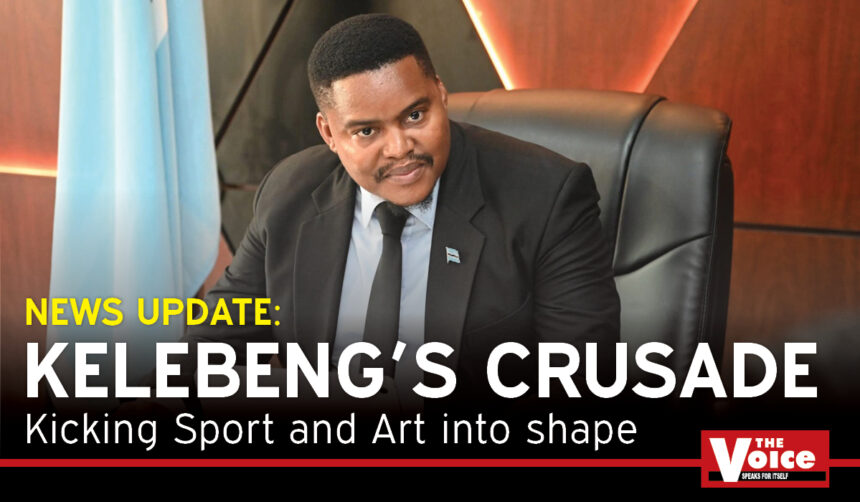
In our first instalment, we feature Minister of Sports and Arts, Jacob Kelebeng.
Although he’s only 36, Kelebeng is already a seasoned campaigner in local politics.
The Motokwe man’s political path was shaped back in 2010 during his time at UB, when he was a key part of the Student Representative Council (SRC), first as Minister of Sports and then as President.
After attaining his Masters in Politics and International Relations, Kelebeng joined the Botswana Movement for Democracy (BMD), later leaving for splinter party, the Alliance for Progressives (AP).
Shaken by a crushing defeat in the 2019 general elections, when he lost out to BDP in Takatokwane, following much soul-searching, Kelebeng made the Botswana National Front (BNF) his home.
It proved an inspired move.
The married father-of-two romped to a landslide victory at last year’s historic election, taking Takatokwane with over 63 percent of the vote.
Let’s find out what makes him tick…
When did your interest in politics begin?
I joined politics during my senior secondary school days. However, I began active politics whilst at University of Botswana. What started as a deep desire to advocate for sport issues in the University ultimately morphed into what it is now… I’m a fully-fledged politician! As a sport person, I was frustrated about the state of sport in the University. To this end, I tried everything I could to ensure the situation is remedied. Unfortunately, I found myself at the freedom square, radical in my pursuit.
Why did you ditch the AP – and are you a member of the BNF?
I’m a bonafide member of the BNF, there should be no doubt about this!
I grew up in a BNF family; both my parents are BNF members. Of course my relations with my mentor, the late Gomolemo Motswaledi led me to BMD and ultimately AP, where I also led the Youth League. Post the 2019 elections after personal reflection, extensive consultations, feedback and well thought considerations I joined the BNF. It was clear the people of Takatokwane couldn’t wait any longer for proper representation and leadership, and that could only be realized through the BNF of UDC. It was a painful decision looking at the relationship I had with leaders and members of AP. But it was also easy for me since I have worked with many BNF cadres through my community volunteerism work and at UDC, including my days as a student activist.
You’ve been the MP for Takatokwane for nine months now – what have you achieved?
As newly elected Member of Parliament I have had to hit the ground running. Our constituency is facing insurmountable challenges. I have been engaged in a series of consultative meetings and stakeholder engagement which sought to ensure that we develop a cohesive and people centred development strategy. We are currently re-thinking how we utilise the Constituency Fund and coming up with a model that will ensure more economic and tangible returns on investment. We are also actively advocating for infrastructural development in our area after years of neglect. I am happy that the Minister of Finance has acceded to our cries to have Lelthakeng-Kaudwane finally becoming a reality. Recently we begun a housing initiative for the needy and unveiled the first house last Tuesday in Maboane. Construction of two more houses in the constituency will also commence in the coming weeks.
Where do you think most politicians trip-up?
Politics is a rough terrain that has many inherent hazards. So there are many challenges that lie in our path. The biggest challenge, however, that politicians can face is when they deviate from a people centered development approach. It is my view that we are merely custodians and servants of those that elected us. I mean this in the true and honest sense. Therefore, whatever we intend to achieve must be guided by their aspirations.
As the Minister of Sports and Arts, do you have plans for similar events like the annual Motokwe Derby Horse Race that can attract tourists from abroad to benefit the country?
We believe that sport and tourism are inextricably intertwined. It is for that reason that sport tourism will be a key theme at our Ministry. Events like Motokwe Derby, and indeed the sport of horse racing are potential areas we can focus on. I intend to support the growth of this sport because we have realised that it traditionally has a huge following. It also gives people in far flung areas [the opportunity] to showcase their talent and receive rewards. For instance, some jockeys are farm labourers. However, they get to make thousands of Pula just from winning a single race. I am happy the Horse Racing Association has now affiliated with the BNSC which demonstrates growth of the sport.
One of the ways we will also grow sport tourism is through hosting of international sporting and arts events. Next year we are hosting the World Relays; this means the attention of the whole world will be on Botswana. Just recently we hosted the Golden Grand Prix. We want to turn this country into a premier location for athletics. There is also another international event that is on the cards. So, work has already started. Ultimately, we will develop a National Hosting Strategy that will guide our efforts and ensure a well-coordinated hosting programme.
What changes are you bringing in sports and arts?
What we are bringing is a well-thought out strategy with key areas clearly outlined. We want to grow sport and arts into a real industry that participates meaningfully in the economy. We do not see sport and arts as a hobby or past time; that is the vision.
Sport and arts will become key economic drivers that create jobs for young people. That is part of our mandate and we will deliver on it. We will commercialise sporting and arts activities ensuring those that participate receive meaningful rewards for their labour. Sport and arts jobs are real jobs and we want to bring about that realisation.
Therefore, what we have done is to develop a strategy that will guide us to achieve that vision. We are deliberate. We want to grow the film industry and we will place the necessary resources to grow this industry. We are currently in the process of securing an excess of P80 million to buy local content. We are also going to ensure these funds trickle along the entire value chain and benefit all artists. These include the actors, actresses, make-up artists, fashion designers, musicians and any other artist participating in the production. We will also buy content regularly to ensure our creatives work throughout the year.
On the sports side, we will prioritise grassroot development and sustainability. It is for this reason that we are bringing back school sport. We will also bring programmes that target out-of-school youth to ensure they are meaningfully engaged. We will also support the continued professionalisation of sport and ensure better welfare of our elite athletes.
You were recently in Hungary on a benchmarking trip; what did you learn that can help grow sport in BW?
Our local sport has been growing steadily. There have been efforts to professionalise especially sport such as football. Our players are also signed to professional teams abroad and many of our youngsters are enrolled in elite universities due to their talent. However, we still have a long way to go, and countries such as Hungary can be a good template for us to learn from. Despite their small population [just over 9.5 million] they have an excellent record in the Olympics. They also excel at hosting events aided by strategic investment in sporting infrastructure. We will therefore not shy away from learning from such countries and building strong partnerships that will enable us to attain our shared aspirations.
How are you finding balancing the dual roles of being an MP and a Minister?
Actually, there are three roles: I’m also a family man. So it’s not been an easy feat especially since we are a new government. We have had to work overtime to rescue the situation that we found this country in. However, I would never complain about the workload because it’s what we signed up for, and in some strange way it’s what we love to do. It is the burden of the calling. I mitigate this challenge by building strong teams at both Ministry and constituency level. This is because I appreciate that we can only succeed due to our collective effort.
Your CV makes for impressive reading, especially in terms of education, professional and political achievements – however, there’s little mention of sport in your past? Where does that come in?
You know, that’s interesting to say because it is sport that actually led me to politics. So make no mistake, I have a track record in sport. I played sports during my school going days as a chess player, karateka and footballer. At UB, prior to becoming the SRC President, I served as the Minister of Sport where I was actively involved in Books League, Intervarsity, CUCSA and BOTESA Games. I had joined student politics primarily because I wanted to advocate for sport issues within the Universities, and unfortunately I strayed into mainstream politics. I have also done sports presenting and analysis in some of the local radio stations. I’m proud to announce that I opened doors for sports presenters such as Martin Fanie Molebetsi, Tumo Stunner Mpatane, and even Alex Basimanebotlhe who became a football pundit on radio and later turned to coaching, he’s currently in charge of the Women’s national team, The Mares.
Sports Associations in the country always seem to be falling out amongst themselves – why is it that these people can’t seem to serve the best-interest of the sport without allowing jealousy and greed to creep in?
What we want to do is that we want to help sporting Associations. We are aware that there has been some challenges across most sporting Associations, so we will help them. One way of doing this is to enhance governance and compliance. Soon we will have a meeting with all associations and these are matters that we will discuss.
We’ve covered the serious stuff, now time for some light-hearted questions. On average, how much sleep do you get in a day?
What is sleep again?
What’s your favourite meal? Drink? Movie? Sport?
Bogobe le seswaa sa kukama. Drink: Apple Juice, Sport; my first love were Football and Horse racing but now I love all sporting codes (laughing).
What’s your strongest trait?
Self-belief and tenacity.
Which football team do you support?
Internationally I support Arsenal and Barcelona, locally I grew up supporting Township Rollers but now I support all local teams (laughs again).
You seem like a calm, level-headed individual who doesn’t get easily flustered? Have you ever been star-struck?
I usually do not get star struck. The only occasions where I get flustered would be instances where I meet our people on the streets and they show so much love. It renews my spirit and my energies: it makes me want to do better!
As Sports Minister, how do you stay in shape, especially with your hectic schedule? Any time for the gym?
I do go to gym at BNSC, but I miss a lot of sessions due to hectic schedule as you already stated..ke stress fela.
How do you relax away from the office?
I usually play some football when I get the chance. If you give me an opportunity I can mesmerize you with my skills!
What’s President Boko like behind the scenes, when the cameras aren’t around?
He is relatable, easy going and interactive. At the same time [he’s] focused and result oriented, always emphasizing that we apply our minds.
Any aspirations on the top job down the line?
My aspiration has always been to become a Member of Parliament for Takatokwane constituency. I’m currently living an answered prayer. Anything beyond is God’s plans.
When your time in office is over, what would you have hoped to achieve – as Minister and as MP?
I would like to have made an impact in all the roles in which I serve. I want to leave sport and arts as key engines of this economy. I want sport and arts to be sustainable, with deliberate programmes in place to nurture and improve performance.
As an MP, I want us to transform Takatokwane from the poorest area in the country to a thriving community. Our focus will be on education, infrastructure development and providing the necessary support for vulnerable sections of the community. For this reason, I established the Jacob Kelebeng Foundation to supplement my efforts as Member of Parliament. Currently we are working with partners to build houses for the needy and provide access to scholarships and other opportunities for people in our community.