


Southern African leaders commit to cross-border protection
Botswana, Namibia, and Angola have reaffirmed their collective commitment to safeguarding the Okavango River Basin, pledging to step up efforts to protect the vital ecosystem.
According to a press statement released on Monday, the high-level pledges were made in New York during a gathering marking the launch of the second five-year phase of Okavango Eternal, a decade-long partnership between the National Geographic Society and De Beers.
The event brought together heads of state, environmental ministers, and global sustainability leaders to reflect on the partnership’s halfway point and to lay out an integrated roadmap for the future.
Among those attending were President Duma Boko, Minister of Minerals and Energy Bogolo Joy Kenewendo, Namibia’s Minister of Agriculture, Fisheries, Water, and Land Reform Inge Zaamwani-Kamwi, and Angola’s Minister of Environment Ana Paula Pereira.
The gathering’s central outcome was to discuss the emerging Okavango Eternal Alliance, a platform designed to facilitate greater coordination among the three governments, ensuring that conservation efforts mirror the natural hydrology of the basin.

The river system relies on a delicate transboundary balance: more than 95 percent of the freshwater that feeds the Delta originates in the Angolan Highlands Water Tower, flowing through Namibia’s Kavango region before discharging into Botswana’s iconic wetlands.
For conservation entities working on the ground, including the Wild Bird Trust and its BW operational arm, the Nkashi Trust, the diplomatic agreement underscores a foundational reality: the Delta cannot be effectively managed without safeguarding its upstream sources.
Speaking on the sidelines of the announcement, Managing Director of Nkashi Trust, Nlisi ‘Chillie’ Motshusi, said the basin’s survival rests heavily on local ownership and integrated expertise.

“The long-term future of the Okavango Delta depends on the people who live here having the knowledge, opportunities and support to care for it. Local knowledge has always been part of how this landscape has been understood, protected and navigated. Our work is about bringing that knowledge together with science, education and sustainable livelihood opportunities to strengthen stewardship of the Delta.”
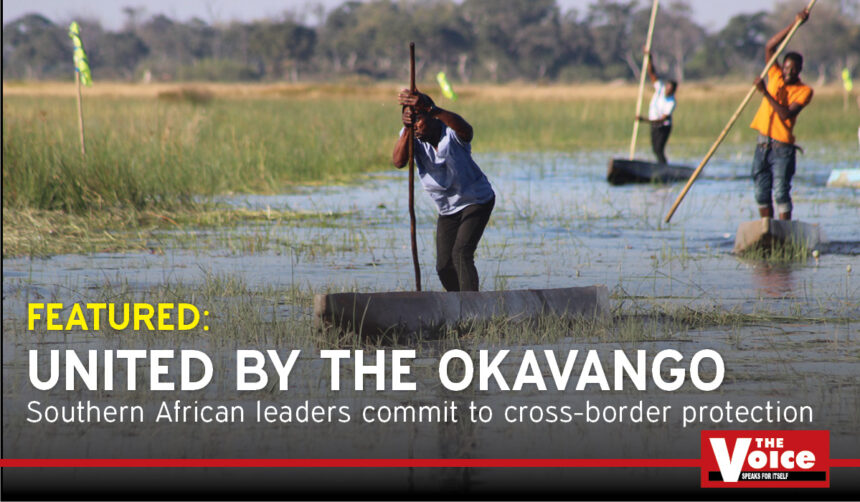
Nkashi Trust leads local field operations under the National Geographic Okavango Wilderness Project (NGOWP), an initiative established in 2015 that traces its roots back to wetland bird surveys launched in 2010 by conservationist Dr. Steve Boyes alongside indigenous baYei polers.
Nkashi Trust has established community hubs, including the Nkashi Knowledge Centres in Maun and Beetsha, alongside a mobile unit known as the Nkashi Knowledge Bus. These hubs offer environmental education, vocational training, small-business support, and platforms for preserving traditional ecological knowledge.
As the second phase of Okavango Eternal gets underway, focus across the three nations will remain on expanding scientific research, developing nature-based enterprises, and strengthening community-led stewardship.
“Botswana has a long history of community stewardship and conservation in the Delta,” Motshusi noted. “The opportunity now is to strengthen those foundations while working more closely with partners across the Basin. The river connects us, and our conservation efforts need to reflect and incentivise that meaningful connection.”