



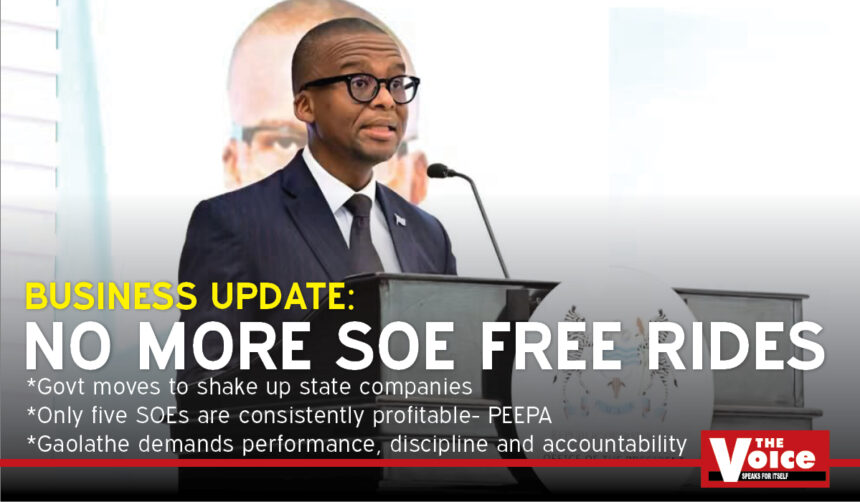
*Govt moves to shake up state companies
*Only five SOEs are consistently profitable- PEEPA
*Gaolathe demands performance, discipline and accountability
Government is moving to overhaul the way it owns and manages State Owned Enterprises (SOEs) as the country faces tighter public finances and pressure to diversify its economy.
The review is aimed at ensuring that mandates remain relevant and operating models are fit for purpose amid tighter fiscal conditions and the urgent need to accelerate economic diversification
The proposed SOE Ownership Policy seeks to make government a more deliberate and strategic owner, including opening the door to private-sector partnerships, restructuring and alternative operating models where necessary.
SOEs have played a vital role in the country’s economy over the years. They have helped expand access to infrastructure, utilities, finance, regulation and social services when markets were still developing.
Vice President and Finance Minister Ndaba Gaolathe, however, is of the view that the country’s economic circumstances have changed, making it necessary to review why government owns certain enterprises and whether they are still serving their intended purpose.

Speaking during stakeholder engagements on the policy, Gaolathe said government must be more disciplined when creating new enterprises and when assessing those already in existence. “The policy asks government to become a more deliberate owner, knowing why we own an enterprise, what we expect from it, how we measure its performance, what risks it carries for the State and what we do when its original purpose is no longer being served,” he said.
State ownership, according to Gaolathe, should only be maintained where there is a clear economic, strategic or social reason.
The reasons, he said, could include natural monopolies and market failures, essential public goods and services, long-horizon infrastructure, national resilience and strategic innovation.

He added that this requires government to treat State ownership as a system in which responsibilities are properly defined.
Currently, Botswana has at least 70 SOEs operating in various sectors of the economy, placed under the oversight responsibility of different government portfolio ministries. From the list, 49 are registered as statutory bodies, five are public companies, seven are private companies, six are limited by guarantee, two are listed entities, and one is regarded as a trust. Further, 18 are classified as commercial, 20 as regulatory authorities, and 31 as developmental SOEs.
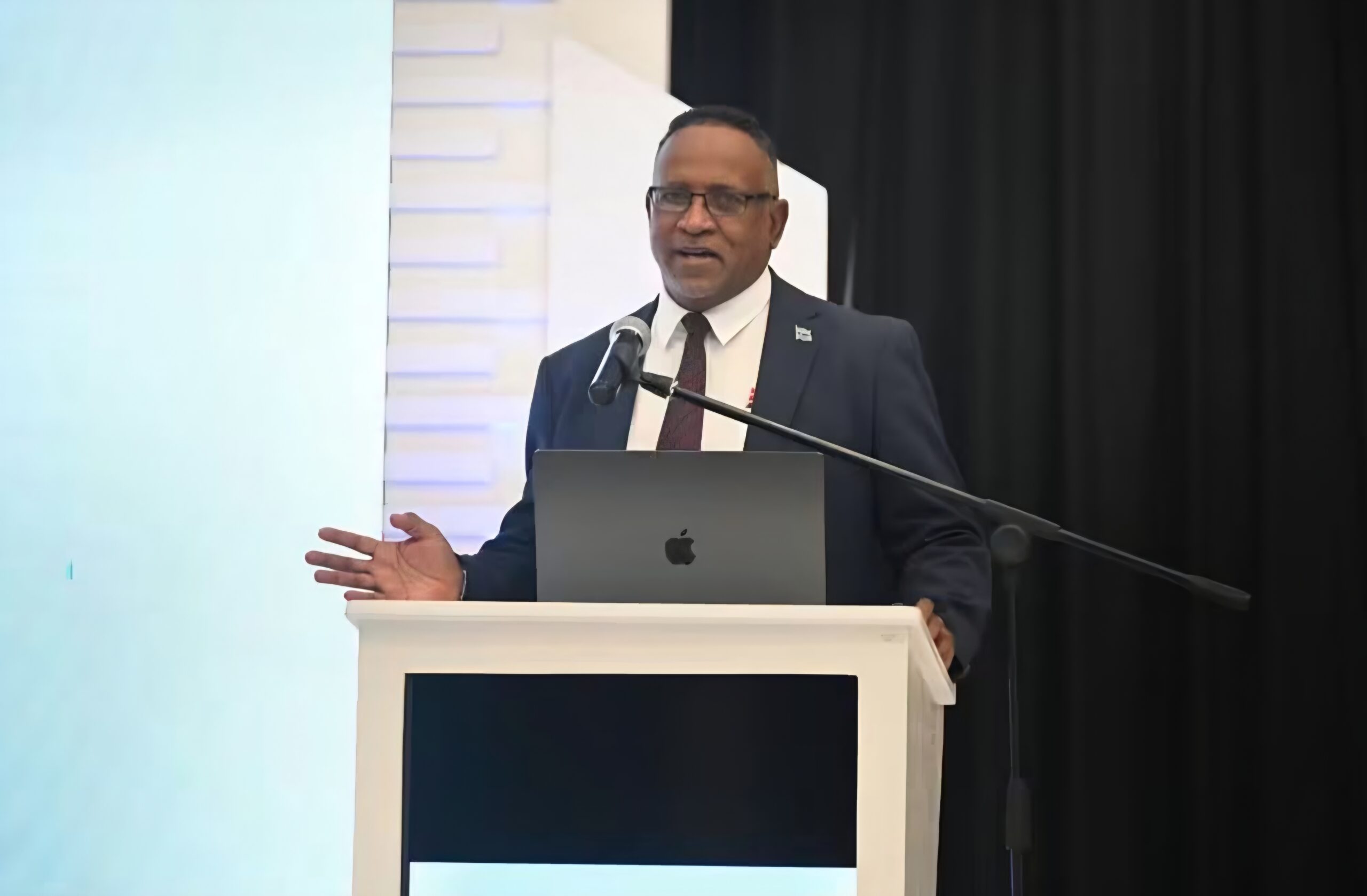
“Before government establishes a new SOE, we should be able to demonstrate the need it meets, whether an existing institution can perform that function and whether State ownership is the appropriate instrument. Existing enterprises must face the same scrutiny against mandate relevance, performance, fiscal exposure, public value and market impact. We must also protect competitive neutrality so that State ownership does not distort the markets we are trying to develop. Where SOEs participate in commercial markets, they should operate on fair and transparent terms that allow private firms to invest, innovate, partner and grow, while State enterprises support national value chains and economic diversification,” said Gaolathe adding that ownership must therefore become more active and measurable.
For his part Public Enterprises Evaluation and Privatisation (PEEPA) Chief Executive Officer Ishmael Joseph said SOE performance matters because government remains the biggest shareholder therefore all should be evaluated periodically as part of active ownership. “Government support remains very significant, while returns from most SOEs are low. Persistent underperformance, heavy dependence on the fiscus, low returns on public capital or weak value creation are incompatible with expected performance standards of SOEs. Reform direction is not just changing funding of SOEs by government but towards demanding high performance, good corporate governance, commercial discipline and strategic relevance,” said Joseph.
According to the 2023/24 and 2024/25 Profitability Performance Review, only five SOEs were consistently profitable, four were volatile while six were structurally constrained. Further a number of SOEs required some type of intervention to support performance enhancement with three needing settlement of government outstanding debt, six for policy support, nine in need of signing and enforcing shareholder compact. Further eight are set to implement the rationalisation recommendations, five set for public service obligation relief, two for recapitalisation while 12 require legislation review.
“The identified challenges experienced by SOEs include over-reliance on government subvention and bail-outs, inefficient operations, outdated business models, public service obligations not compensated on time and lack of innovation, digital transformation and competitiveness. This extends to overlapping mandates and duplication of functions amongst SOEs, no separation of roles in some cases where government is both the owner and regulator – with no independent regulator as well as weak governance and accountability, with shareholder overreach,” explained Joseph declaring that sometimes board appointment system are not even aligned to best practices while ownership policy and oversight roles are also not effectively enforced.