




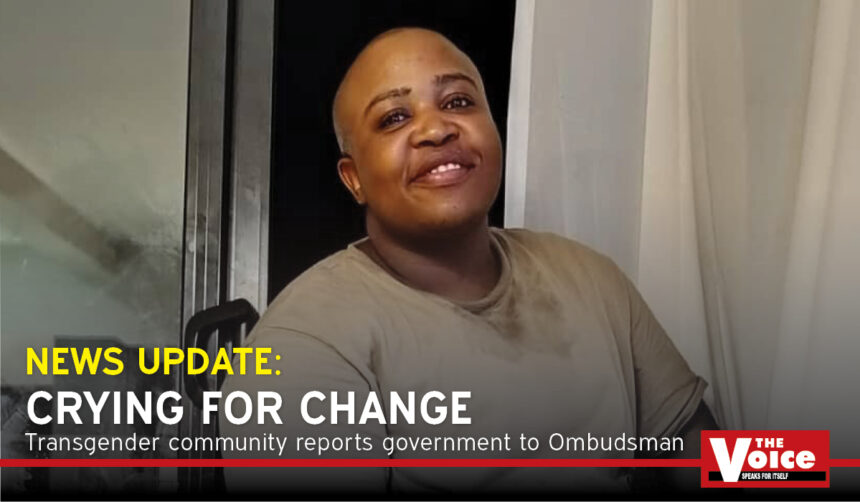
Transgender community reports government to Ombudsman
Nine years after the High Court granted Botswana’s transgender community the right to legally change their gender marker, human rights activists have accused government of playing hard ball with the directive.
Indeed, since the 2017 judgement, not a single transgender person in Botswana has been able to alter their marker- a designation like M for Male, F for Female, or X for non-binary/other- used on official documents, databases, and forms to indicate a person’s gender identity.
Fed-up, the transgender community have now escalated their grievances to the Ombudsman, alleging that the government has failed to implement landmark High Court rulings granting them their rights.
Two High Court judgments in 2017 found that refusing to enable transgender persons to change their gender marker without resorting to litigation violates an individual’s rights to identity, dignity, privacy, protection from discrimination, degrading and human treatment, freedom of expression, association and assembly.
At the centre of the controversy is the government requirement, through the Office of National Registration, that transgender persons obtain a court order and provide a medical report proving they have undergone medical transition before their gender marker can be changed.

Transgender activist and student at University of Botswana, Phio Kenosi, says they have been unable to change their gender marker due to the financial and procedural hurdles imposed by the current system.
“I have even tried to get medical reports from government hospitals but I haven’t been successful. It requires that I should have money to engage private hospitals which is quite expensive,” added Kenosi
In one of the 2017 cases, the High Court granted a judgement in favour of a transgender man known as ND, ordering the Registrar to change his gender marker from female to male. In a separate judgement, Justice Leatile Dambe ordered the Registrar to change Tshepo Ricki Kgositau’s gender marker from male to female.

Kgositau, a law reform expert with the Global Equity Human Rights Programme, revealed to The Voice that the two cases set a legal precedence that should require every transgender person to approach the Registrar directly without needing a new court order to change their gender marker.
“The current process is a cumbersome excise that requires individuals to seek legal representation. The process is quite exclusionary despite previous court rulings declaring that refusing to provide an individual an opportunity to change to their preferred gender was unconstitutional,” said Kgositau.

She said there are no administrative mechanisms in place to assist individuals who lack financial resources to pursue legal action, effectively shutting out many who wish to exercise a right already affirmed by the courts.
“The transgender persons are forced into identifying themselves to an identity that has been assigned to them by the state. Those who can’t afford the arbitrary route are excluded and this is contrary to the principle of self-determination,” she added.
“There are also transgender and intersex individuals who do not identify within the male-female binary and prefer an ‘X’ gender marker,” she said, noting that the current system does not provide for them.
She expressed concern that the government has not developed clear guidelines or standard operating procedures to implement the High Court rulings, leaving transgender individuals at the mercy of discretionary decisions by officials.

Kgositau is worried about the apparent lack of state support for medical transition services in line with international standards and believes the absence of public healthcare options places an additional financial burden on the transgender community.
In response to the concerns, Ministry of Labour and Home Affairs spokesperson, Moreri Moesi, confirmed that the government still requires a court order and a medical report for a gender marker change.
“Changing a gender marker cannot be done without undergoing medical transition and producing a report to that effect, unless one can prove that their gender was erroneously recorded,” he said.
Kgositau said the transgender community intends to return to court to seek a declaratory order affirming that individuals should be granted an opportunity to change the gender marker even when they have not fully undergone medical transition.
Human rights group, Success Capital has also described the current process as tedious.
It’s Director, Dumi Gacha, said that they have been approached by two Botswana nationals seeking asylum in United Kingdom who wanted guidance on how to navigate the legal system in changing their gender marker.
“Our role is to guide and link them with possible legal support which has become increasingly limited following the recent international aid cuts. At present, one needs to approach the High Court,” Gacha said.
Rantao Attorneys, Senior Counsel, Tshiamo Rantao said that if indeed the Registrar refuses on the basis that he needs a court order to effect that change, then the Registrar would be acting unlawfully by refusing to exercise his statutory discretion in the first place.
“The Registrar ought to follow the principles enunciated by the High Court in the ND ruling whenever he receives any such request,” said Rantao.