

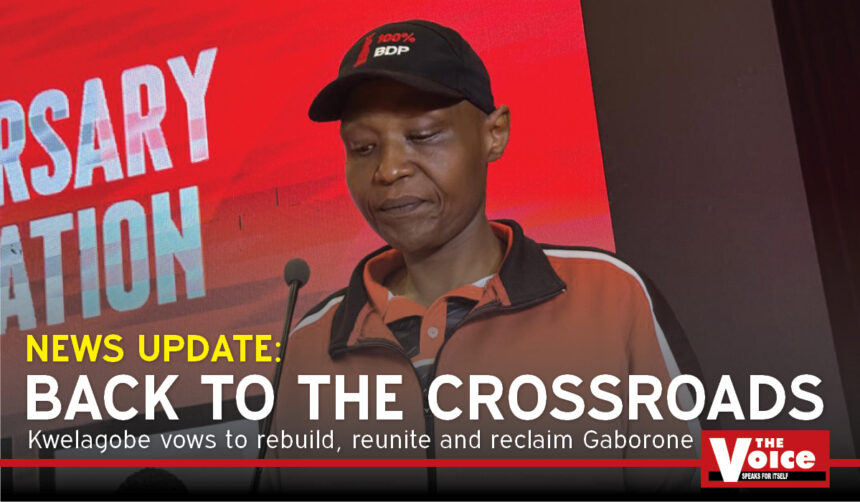
Kwelagobe vows to rebuild, reunite and reclaim Gaborone
Having risen through the ranks of Botswana Democratic Party (BDP), Kagiso Kwelagobe is no stranger to leadership.
From serving as Deputy Treasurer at ward level to Branch Treasurer and later Regional Treasurer, Kwelagobe now steps into a bigger role as the newly elected Chaiperson of the Gaborone Region.
Fresh from his unopposed victory, he speaks to The Voice Reporter DANIEL CHIDA about rebuilding the party, restoring unity, and winning back urban voters.
Congratulations on your win. How do you feel about the victory?
Thank you very much. I receive this responsibility with humility and a deep sense of duty to serve the democrats of Gaborone and the broader movement.I am deeply grateful for the confidence that democrats have placed in me. I am even more humbled that this was a collective decision across the entire region as I was elected unopposed. This is not a personal victory but a mandate to rebuild, to unite, and to reposition the BDP in Gaborone.
What motivated you to run for the position?
We are at a defining moment as a party, particularly in Gaborone. I was motivated by the need to contribute meaningfully towards restoring unity, rebuilding trust, and reconnecting the party with the people. I believe strongly that the BDP still has a critical role to play in Botswana’s future, and I felt compelled to be part of that renewal.

What did you do differently to win the chairmanship?
My campaign was grounded in deep engagement and active listening. I took time to understand the concerns of democrats across branches, candidly acknowledging where we have fallen short, while presenting a clear message anchored in unity, discipline, and renewal. It was a campaign driven by purpose, one that did not shy away from introspection. I engaged democrats honestly about how we arrived at this moment, openly admitting where we lost our way, and reaffirming my unwavering commitment to correcting the missteps of the past and restoring the strength and integrity of our movement in Gaborone.
What are your priority goals?
The underlying foundation of my roadmap is anchored on the principle of going back to the crossroads (marakanelo). The crossroads is a moment of pause, reflection, and honest introspection. It is where a people deliberately assess their journey, acknowledge where they may have gone astray, and consciously choose the right path forward. For us as democrats, the crossroads is not a place of weakness, but rather a place of renewal. It is where we reconnect with our founding values, restore our sense of purpose, and recommit to the principles that once made our movement strong, united, and trusted by the people. Our immediate focus is to restore unity within the region, address issues of indiscipline, rebuild trust within our structures, and reconnect meaningfully and honestly with the electorate. We are committed to strengthening party structures, empowering young democrats, and reconnecting meaningfully with the electorate. We must ensure our messaging speaks directly to the lived realities of Batswana.
How will you achieve your goals?
Through consistent engagement, structured programmes, and accountability. We will traverse the length and breadth of every constituency, listening actively and ensuring decisions reflect grassroots voices. Discipline will be enforced fairly and unity will be deliberately cultivated. We also aim to align our structures to be more responsive, people-centred, and attuned to the realities faced by our communities. All of this will of course be underpinned by the “fierce urgency of now” a recognition that the time for renewal, action, and decisive leadership is not in the future, but in this very moment.

What changes should the BDP members expect soon?
Members will see a more organised and visible structure, stronger engagement at grassroots level, and clearer communication. Leadership will be consistent, transparent, and fair. Importantly, we will return to grassroots politics, community meetings, workshops, and direct engagement with citizens, not relying on luxury settings but meeting people where they are. You see, that is where true engagement happens. That is how you connect with communities at a personal level, by living among them, understanding their realities, and walking the journey with them as you collectively chart a path forward.
The BDP once dominated Gaborone. What went wrong?
To be candid, this is a personal view that has often invited criticism from within our own ranks, but I believe that what happened in 2024, difficult as it was, came at the time it needed to. It served as a necessary moment of reckoning for the movement. That said, the shift we experienced cannot be attributed to a single factor. It was the result of a combination of issues like complacency over time, the complexities and unintended consequences of our “Bulela Ditswe” primaries, a growing disconnect from the evolving needs of urban voters, internal divisions, and ineffective communication. You see, Urban electorates are dynamic and constantly evolving, and where we failed to adapt, we inevitably lost ground.
How will you rebuild the trust of urban voters?
Look, trust is rebuilt through honesty, presence, and delivery. We must acknowledge past mistakes and offer realistic, practical solutions. Urban voters want sincerity and clarity. We must avoid overpromising and instead focus on credible, achievable plans that address their daily challenges. Our responsibility is to restore hope not through rhetoric, but through practical, honest, and achievable solutions that resonate with the everyday experiences of Batswana, young and old.
How would you compare the BDP of today to the past?
The BDP of the past was deeply rooted in understanding the needs of our people and crafting meaningful programmes and initiatives that served them effectively. On the question of unity, while the party has always had factions, those differences were largely ideological in nature. Importantly, at critical moments, especially during elections, a common ground was always found in recognition of the bigger picture and the collective interest of the Party. In my view, this was largely underpinned by a strong culture of discipline and an unwavering commitment to placing the party above individual interests. Those values remain our foundation, but over time they have been tested. The task before us is not to reinvent the Party, but to realign ourselves with these core principles, while adapting to the realities of a changing political landscape.
From your personal perspective, what were the party’s biggest mistakes?
Quite frankly, we did not listen enough. We allowed internal divisions to fester, and at critical moments, we became inward-looking when we should have been fully attuned to the everyday concerns of our people. At times, we appeared distant from the realities on the ground. Our communication also fell short, we failed to effectively counter misinformation and did not clearly articulate our value proposition to the electorate. In many ways, we allowed our internal processes to supersede the genuine needs of the people, and in doing so, we became increasingly divided. That disconnect cost us, and it is a lesson we must take seriously as we rebuild.
Do you believe BDP can return to power?
Absolutely. The BDP remains the most experienced and well-structured political movement in this country. Notwithstanding the recent outcome, we are still the single largest political party in Botswana. With the right level of introspection, a genuine commitment to unity, and a focused process of renewal, I have no doubt that we will return to government. In fact, I believe that return may come sooner than many anticipate.
What must fundamentally change for that to happen?
We must restore unity, strengthen discipline, reconnect with the electorate, and embrace a culture of accountability. At the same time, we must modernise how we engage, communicate, and respond to the evolving needs of Batswana. Critically, we must also undertake a careful realignment of our constitution to reflect present-day realities and ensure that it is more inclusive, responsive, and fit for purpose. Above all, we must be honest with ourselves and with the people we seek to serve.
If you fail to deliver on your roadmap, how will you be held accountable?
Well, leadership must be accountable. I will subject myself to the structures of the party, provide regular progress reports, and remain open to scrutiny. If we fall short, I will take responsibility and allow the democrats to determine the way forward.
There are perceptions that your father influenced your rise. How do you respond?
I have deep respect for my father and his contribution to the party. However, I stand here on my own record, my own work, and the confidence that democrats have placed in me. Leadership positions in the BDP are determined by the will of its members. I engaged democrats directly, presented my vision, and earned their support. My journey in the party has not been overnight, I have worked tirelessly and served across multiple structures, from the grassroots (ward, branch) to the regional level. This mandate is a reflection of that journey and the trust that has been built over time. To those who hold the view that my father influenced this outcome, I say they are misinformed. In fact, he was not involved in my campaign at any point. Out of a conscious effort to avoid exactly such perceptions, I even kept him away from what would have otherwise been a proud moment for any father; to witness his son step into leadership. It was not an easy decision, and I know it was painful for him, but it was necessary. Perhaps the perception also stems from the fact that my campaign drew inspiration from his well-known message at the funeral of former President Quett Masire, where he urged us to retrace our steps back to the crossroads (Marakanelo). That message resonated deeply with me, not because of who delivered it, but because of its truth.Had we internalised those words then, we may not find ourselves where we are today. And even now, their relevance is more critical than ever. My commitment is to ensure that those principles of reflection, correction, and renewal are not just spoken about, but actively put into practice.