



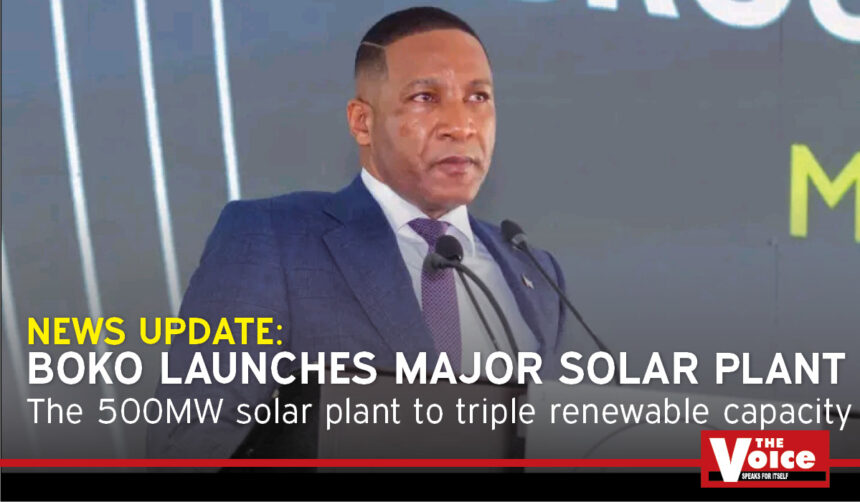
The 500MW Solar Plant to Triple country’s Renewable Capacity
In a historic move that signals a new era for Botswana’s power sector, President Duma Boko inaugurated a 500MW Solar PV Plant and 500MWh Battery Energy Storage System (BESS) in Mawana, near Maun, last Thursday, declaring that the nation is acting not out of mere obligation but out of a profound necessity to secure its future.
The project, which stands as the largest grid-scale solar project in Botswana and the second-largest energy storage facility on the African continent (after South Africa’s 1,140MWh battery system), marks a decisive shift from a fossil-fuel-dependent past toward a diversified and sustainable energy mix.
Developed through a strategic partnership with O-Green of Oman, the facility is the flagship initiative of a renewed and accelerated Integrated Resource Plan aimed at turning Botswana into a regional energy powerhouse.
Addressing a crowd of dignitaries and residents near the gateway to the Okavango Delta, President Boko emphasised that the launch represents the tangible realisation of Vision 2036.
He told the gathering that his aspirations for a “New Botswana” are rooted in providing secure, affordable, and sufficient power for all while positioning the country as a net exporter of electricity by 2030.

“Today signifies a move from plans to action,” President Boko stated. “We are decisive in transforming our energy sector from fossil-based to a diversified energy mix, comprising both renewable and non-renewable sources. Our goal is to elevate Botswana’s stature on the global energy landscape.”
The president noted that while Botswana currently derives only about 8% of its power from renewables, the target is to surge that share to 50% by 2030.
To achieve this, the government is fast-tracking the delivery of 1.5 GW of renewable energy. This ambitious roadmap is supported by a significant Power Purchase Agreement between the Botswana Power Corporation and O-Green for the development, financing, and maintenance of the Maun plant. President Boko extended his sincere gratitude to the Sultanate of Oman, noting that such government-to-government collaborations are essential to bringing these large-scale endeavours to fruition.

Beyond the technical specifications, the president framed the transition as a vital response to the climate crisis.
He acknowledged that while Botswana contributes a tiny fraction, approximately 0.02% to global carbon emissions, the nation remains among the most vulnerable to persistent droughts and extreme temperatures.
He argued that the transition to clean energy is a responsibility the country owes to its people to ensure economic stability in the face of environmental stress.
Central to the president’s message was the insistence that this “green revolution” must be inclusive.
He highlighted that the government has taken deliberate steps to ensure Batswana are not just consumers of energy, but owners of the industry.
This includes reserving small-scale solar projects for citizen-owned companies and requiring a minimum of 40% citizen shareholding in larger utility-scale projects.

Already, small-scale solar capacity has expanded from 32 MW to 181 MW across the country, while 468 out of 565 villages have now been electrified.
As the Maun plant begins its journey toward injecting 500 MW of clean power into the national grid, it joins other successful ventures such as the now-operational Mmadinare plant and the Jwaneng project, which is expected to be fully operational by mid-year.
Boko concluded by describing the occasion as a catalyst for national progress, building an economy that is competitive, modern, and, most importantly, powered by the 3,200 hours of sunshine Botswana is blessed with annually.