


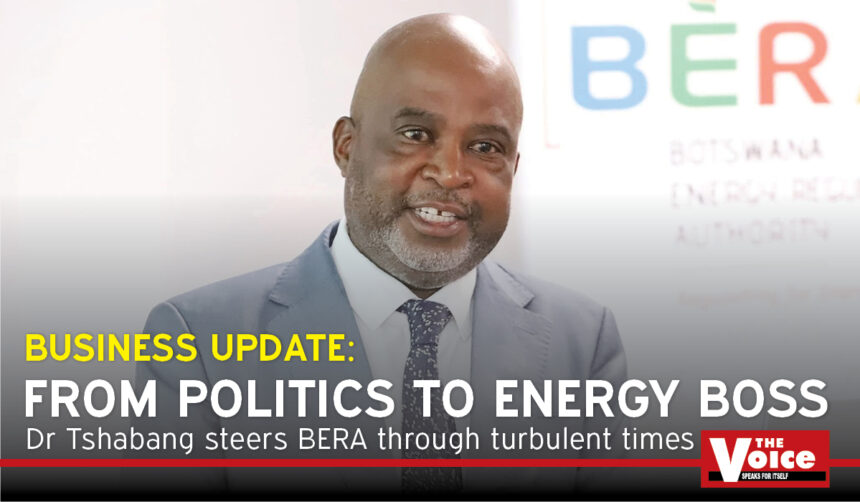
Dr Tshabang steers BERA through turbulent times
Dr Never Tshabang stepped into the demanding task of leading the Botswana Energy Regulatory Authority (BERA) last year in August as its Chief Executive Officer, inheriting the entity at a time of shifting market dynamics and global turmoil.
With the conflict in the Middle East sending shockwaves through oil markets, the former academic and politician now balances accelerating national energy transitions with maintaining traditional supply security.
Dr Tshabang is a seasoned scholar who spent nearly three decades lecturing and conducting research at the University of Botswana. He has also served as Member of Parliament for Nkange Constituency.
Now, the Maitengwe native has traded lecture rooms and political podiums for the corporate world where he is responsible for price regulation, tariff setting, licensing, compliance, consumer protection, and environmental oversight.
Who is Dr Tshabang outside the corporate walls of BERA?
I was born in 1972 in Maitengwe village. I hold a PhD from the Australian National University, Masters of Sciences from University of Sussex, UK, BSc (University of Botswana) degrees in Chemistry and Masters of Business Administration (UB).

It’s been almost 9 months since your appointment at BERA, how do you find your stay there?
The past nine months have been both engaging and insightful. BERA plays a critical role in Botswana’s energy sector, and I have found the environment highly dynamic. It has been a period of learning, stabilising key areas, and strengthening internal systems to ensure we deliver effectively on our mandate. It comes with its fair share of challenges as you know we are currently in the middle of arguably the most volatile situation by far, but we continue to monitor developments and give advice and guidance to the relevant authorities.
How has the transition been, from politics to the corporate?
The transition has been smooth but requires a shift in approach. While politics is largely people-centric and policy-driven, the regulatory environment demands technical precision, consistency, and adherence to frameworks. However, both spaces require leadership, dynamism, accountability and decision-making, so the skills are transferable. But I continue learning every day. I am also of the firm believe that change in focus brings growth, enrichment and better professional outlook. I am also grateful of the opportunity to lead an organisation with mandate of this magnitude. At the end of the day one’s profile of an academic, legislator and corporate leader is a propound one and I am happy to possess such a profile.
As a new leader, did you have any roadmap for the organisation?
Yes, upon assuming office, my priority was to ensure continuity while also strengthening institutional capacity. The roadmap focuses on improving regulatory efficiency, enhancing stakeholder engagement, ensuring compliance, and promoting transparency within the energy sector.

People often confuse your mandate with Botswana Oil Limited—can you clarify?
BERA is a regulator, while Botswana Oil Limited is a commercial entity. Our role is to license, monitor, and regulate the energy sector to ensure compliance, fair pricing, and consumer protection. Botswana Oil, on the other hand, is involved in the procurement, storage, and supply of petroleum products. We provide oversight; they participate in the market.
What legacy do you want to leave behind at BERA?
I would like to leave behind a strong, transparent, and efficient regulatory institution that is trusted by both industry players and the public. A BERA that is proactive, responsive, and aligned with Botswana’s energy security goals.
Road and fuel levy were recently suspended—why didn’t consumers see a significant price drop?
Fuel pricing is influenced by multiple factors beyond levies. While the suspension of the road and fuel levy provides relief, global oil prices, exchange rates, transport costs, and regional pricing structures still play a significant role. The suspension helped cushion consumers from even higher increases rather than creating a drastic reduction.
What factors influence fuel pricing?
Fuel prices are largely determined by, International oil prices, exchange rates, Importation and transportation costs, industry costs and margins as well as Government levies and taxes, all these components combine to determine the final pump price.
How is BERA ensuring consistent fuel supply and managing costs?
We work closely with key stakeholders to monitor supply chains, enforce compliance, and ensure adequate reserves. Through regulatory oversight, we aim to maintain security of supply, stability, and in some cases Government absorbs costs that may not necessarily be part of the slate (pricing structure) , meaning that Government would pay importers additional costs (premiums) over and above normal slate costs.
What action will be taken against non-compliant licensees?
BERA takes compliance seriously. Measures include, issuing warnings and compliance directives Imposing penalties and fines suspension or revocation of licenses in severe cases. Our goal is to maintain integrity and accountability across the sector.

How will BERA improve public knowledge on energy regulation?
In the near future we will be rolling out a campaign to strengthening our public education and communication strategy through media engagement, stakeholder outreach, and digital platforms. First on the books was media engagement both with editors as gate keepers and with the journalist on the ground on the 11th May 2026. We will also be making use of our social media to break down jargons; the aim is to simplify information and make our role more accessible and understandable to the public.
Do you miss politics? Would you return?
Public service remains important to me, whether in politics or administration. For now, my focus is fully on my role at BERA. The future will depend on where I can best serve the nation.
Are electricity prices set to increase?
Tariff adjustments are guided by regulatory processes and cost-reflective principles. While reviews do occur, any changes will be communicated transparently and in consultation with stakeholders. At this stage, no confirmed adjustment can be announced without due process but we can confirm that BERA has received a request from Botswana Power Corporation (BPC), where they sought to have 46 percent increase in electricity tariffs. As indicated above due process is currently underway, a public hearing was held back in February 2026. On the BERA side the process has been completed and recommendations made to government and official announcement will be made through the official channels.
Why aren’t we seeing more solar power projects in Botswana?
There is growing momentum in renewable energy, particularly solar and as of May 2026 there is 15 percent renewable energy contribution to the Botswana energy mix. However, projects require investment, infrastructure, and regulatory alignment. BERA is working to create an enabling environment that encourages more participation in renewable energy development. As you maybe be aware Botswana has set itself a 50 percent target for penetration of renewable energy in national energy mix by 2030, so far we have approximately 700MW of solar projects that are under construction namely, the recently launched Maun 500MW solar project, the Jwaneng 100 MW solar project as well as the 100 MW Mmadinare solar project. In addition to the above the Roof-Top Solar (RTS) programme is ongoing and currently an aggregate of 5 MW solar capacity has been awarded to commercial and industrial customers as well as residential customers. We hope that RTS will grow and we encourage households to apply.
Take us through an average workday in your life
My day typically starts early with a review of key reports and updates. The day is filled with meetings, both internal and with stakeholders, focusing on regulatory matters, strategy, and operations. I also dedicate time to decision- making and reviewing sector developments. Evenings are usually for reflection, reading, and preparing for the next day.
Personal Profile
Name: Never Tshabang
Date of Birth: 02 February 1972
Home Village: Maitengwe
Favourite Meal: Zembgwe (millet) with traditional chicken
Favourite Drink: cold drink in summer and hot beverage in winter
Inspirational Quote: Well began is half done
Favourite Holiday Destination: Maun
Hobby: Farming (cattle) and football, I am an Arsenal fan.