
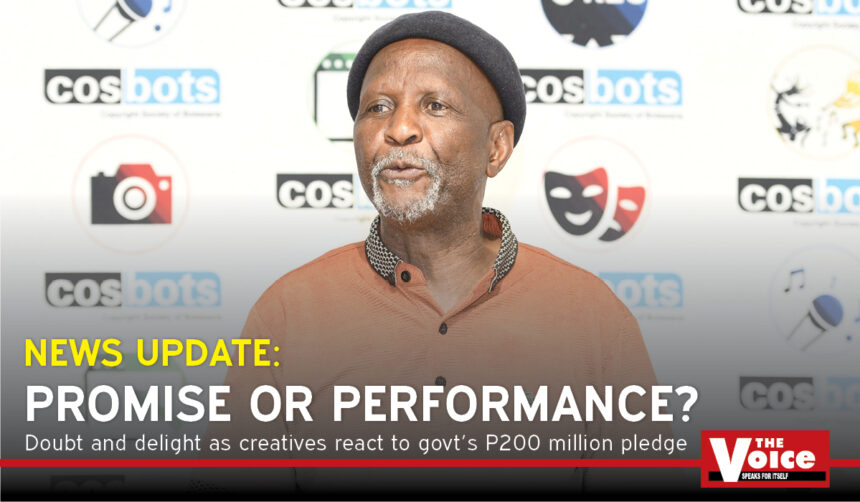
Doubt and delight as creatives react to govt’s P200 million pledge
“I’m delighted to announce that government has taken a decision to avail P200 million from the Alcohol Levy Fund towards procurement of creative arts content from our young people. At the best of times, the budget was about 2 million. It is now being raised to 200 million.”
When President Duma Boko made this thunderous declaration during his 2025 State of the Nation Address on Monday, Botswana’s creative circles erupted, some with joy, others with suspicion.
The long-neglected creative industry, often starved of resources and recognition, was suddenly at the center of a national conversation.
But as the echoes of that announcement settled, responses from creative bodies revealed both hope and hardened skepticism.
The Botswana Entertainment Promoters Association (BEPA) was among the first to issue a formal response, welcoming the investment but warning against short-term gratification.

BEPA applauded the P200 million allocation plus the creation of a Presidential Youth Empowerment Initiative that includes content creation hubs.
However, the association urged government to shift focus from content procurement to building a creative sector capable of sustaining itself.
“Government has previously invested in purchasing creative content through promoters, and while this is appreciated, we call for development frameworks across sub-sectors enabling them to produce for both local and international markets. Only then can the creative industry meaningfully contribute to Botswana’s P338 billion GDP target and the P589 billion private sector investment goal.”

BEPA further called for an empowered, autonomous National Arts Council of Botswana led by professionals with sector expertise to administer levies and funds transparently.
Their vision is of a creative industry that fuels sustainable entrepreneurship, bolsters GDP, and integrates entertainment as a pillar of tourism.
“Entertainment,” BEPA noted, “should be woven into the very soul of our tourism and economic diversification strategy. It is the window into the culture of a Motswana, the story of who we are and why the world should invest here.”
Not everyone was convinced.
Arthur Makhwenkwe, Chairperson of the recently formed Botswana Music Legends Association (BOMLA), dismissed the announcement as ‘a pipe dream’.
“They need to call all associations every one of them and hold a full meeting with the leaders before deciding anything. Otherwise, it’s just politicians using artists to enrich themselves. At the end, the money isn’t accounted for, and artists remain poor. Tomorrow, they’ll blame us for mismanagement. It’s a political gimmick.”
His words echoed the sentiment of many veterans who have watched promises come and go, often leaving artists with nothing but applause and empty pockets.

For Earnest Seakgosing, Chairperson of the Botswana Screen Society, the announcement represents victory after a relentless campaign.
In his piece ‘The Story Behind the P200 Million Film Industry Revitalization’, Seakgosing chronicled the uphill battle to redirect funding from the controversial Steve Harvey Project, which he claims received around $69 million (P969 million) under the guise of developing Botswana’s film industry but left local professionals out in the cold.
“For over six years, there were no BTV production tenders. The Now Channel under MYSC failed to commission local content for three years. The sector suffocated.”
The Screen Society and its allies petitioned government to freeze and audit the Harvey Project and redirect P200 million to revive the national film and television industry. After years of advocacy, October 2025 brought a breakthrough: official recognition and approval of their proposal, Project Phoenix, a vision to modernize BTV and restore dignity to the screen sector.
Seakgosing outlines the projected impact: 7, 800 to 9, 000 jobs per year between 2025 and 2026, doubling in 2027 and 2028 as two BTV channels operate, totaling up to 54, 000 jobs over four years.
“This is not just a financial injection, but a rebirth, proof that when Botswana’s creatives unite, their voices can move a nation.”
Jazz songstress Kearoma Rantao, speaking on behalf of the Women of Jazz, expressed frustration rooted in years of disappointment.
“We are essentially saying the money has once again landed in the wrong hands. We have seen funds and millions go to people who claim to empower artists but instead use that money for their own personal gain. They write impressive proposals, get access to large sums, and only engage a few artists to make their projects look legitimate, paying them next to nothing while they walk away with millions. We have tried to apply for such opportunities too, but we never got any response,” Rantao raged, adding the funding, if managed properly, could transform the creative landscape across Botswana.
“We very much appreciate it,” she concluded, “but it must be used wisely!”
For Zenzele Hirshfield, Director of Zen Promotions, the P200 million pledge is good news, but one that demands fairness.
“As we welcome this allocation, we must recognise the vastness of our ecosystem from performing and visual arts to film, music, design, and publishing,” she said.
“Every sub-sector deserves consideration. The government must ensure inclusive, equitable distribution of resources, empowering youth and emerging artists. Let’s harness this investment to create a thriving creative economy that showcases Botswana’s rich cultural heritage to the world.”
The P200 million announcement has sparked mixed emotions on both ends of the scale. For some, it’s a long-awaited turning point, for others, a familiar political performance.
The stage is set. The script is written.
Now, it’s time to see whether this act ends in revival or just another reprise.