




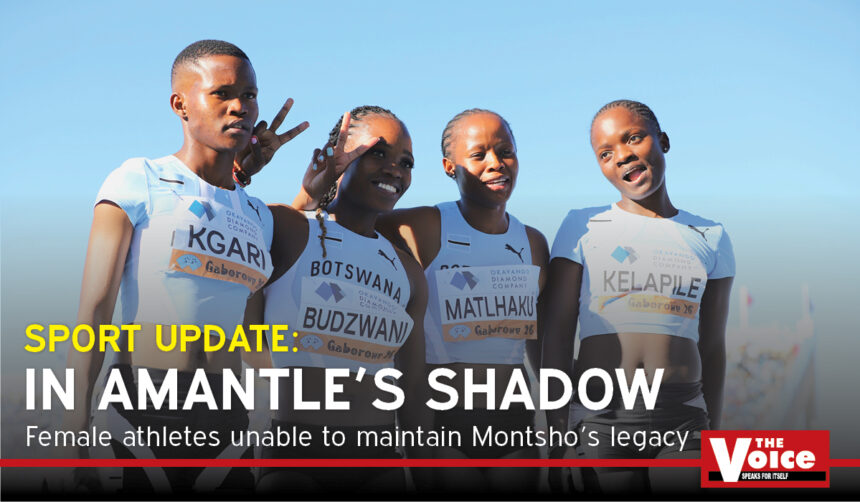
Female athletes unable to maintain Montsho’s legacy
Long established as the country’s most successful sporting code, Botswana’s athletic pedigree is world renowned.
It is also extremely one-sided.
While the men continue to spread fire across the globe, winning medals and glory galore, the local ladies have been caught cold, lagging behind in the shadows, unable to make any sort of impact on the world stage.
It was not always that way!
In Daegu 15 years ago, the great Amantle Montsho brought the heat to South Korea, motoring to history in the women’s 400m to become Botswana’s first-ever world champion; indeed, the Maun native’s gold was the first medal of any kind won by a Motswana at the global event.
A year later, at London 2012, the then 29-year-old narrowly missed out on the country’s maiden Olympic medal, finishing in 4th place, piped to the podium by America’s Dee Dee Trotter. A teenage Nijel Amos would heal the country’s heartache days later!

A failure to dip on the line would haunt Montsho in Moscow the following year, when she missed out on defending her world title, run down by Christine Ohuruogu of Great Britain. The clock had the gap between the two women at four thousandths of a second.
It was a mark of her dominance at the time that the silver was tinged with disappointment, despite it being only BW’s second World Championship medal.
During this unprecedented period of supremacy, Montsho would win the coveted diamond league three years straight (2011 – 2013), a feat that remains unmatched by any local athlete, male or female.

Although the Olympic medal would allude Montsho, her crammed trophy cabinet includes two Commonwealth Golds – the first of which was claimed in Delhi 2010, making her Botswana’s first Commonwealth champion.
Montsho reigned supreme on the continent too, winning in Addis Abba, Nairobi and Porto-Novo to boss the biannual African Championships from 2008 to 2012.
A failed drugs test at the 2014 Commonwealth Games in Glasgow, when she tested positive for the banned stimulant methylhexanamine, marked the beginning of the end for the 400m legend.
There was still time for one last hurrah at the Gold Coast in 2018, when a returning Montsho crossed the line first to claim her second Commonwealth title; she remains the only lady from Botswana to hold that title.
Indeed, there has been precious little to get excited about from a female perspective since Montsho hung up her spikes four years ago.
This growing gap between the boys and the girls was clear for all to see at the Debswana World Athletics Relays in Gaborone last month, when the men’s 4x100m and 4x400m relay teams eased to automatic qualification for next year’s World Champions in Beijing.

The women, however, fell well short.
The trio tipped to continue Montsho’s 400m legacy, Christine Botlogetswe, Galefele Moroko and Lydia Jele failed to live up to their early hype.
Botlogetswe, who turns 31 in October, has appeared in two Olympics, but failed to progress beyond the heats, a hurdle which also proved 29-year-old Moroko’s undoing at Toko 2020.
Jele, meanwhile, saw her promising career cut short by two doping bans, the latest of which runs until 2032, by which point she will be 42.
In spite of the fairer sexes’ struggles, veteran athletics coach, Justice Dipeba assured Voice Sport the solution is simple.
“We should take them out of the home environment and put them in a high performance environment that will be able to help them to perform at elite level. The only thing that I think we’re doing wrong as a country is that we are not intentionally supporting these women in terms of making sure that we take them out of the home environment where they are given so much responsibilities as young women. We need to put them in a high performance camp where they will be more focused on performing, looking after themselves and on running than anything else,” advised Dipeba, adding one of the reasons Montsho was so successful is because she was based in a centre in Senegal.
Similarly, the respected coach attributed Oratile Nowe’s recent rise to her training at Sepeng Athletics Project in Pretoria, South Africa.
The 26-year-old has been a rare bright spark on the women’s side, triumphing at the Golden Grand Prix in Gaborone in late April.
Named the Botswana Sportswomen of the Year, Nowe continued her fine form with a silver medal at the African Championships in Ghana two weeks ago, before bagging a commendable 4th place finish in the Rabat leg of the Diamond League on Sunday.
The diminutive middle distance runner is the national record holder over 800m, 1, 000m and 1, 500m; now she need to transfer that local dominance to the international arena.
Upcoming talents: Sethunya Majama, Batisane Kennekae and Obakeng Kamberuka have all shown sparks of brilliance too. 22-year-old Kamberuka in particular looks to be one to look out for, backing up spirited runs at the World Relays with silver in the 400m in Accra.
Reached for his thoughts on the ladies’ prolonged plummet from the world stage, Botswana Athletics Association Vice President Technical, Kenneth Kikwe said, “Women tend to be discriminated for acquiring muscular bodies and we lose a lot of talent due to that because some women don’t want to build muscles. Training from home is not sustainable because they are expected to do household chores so those duties are a challenge to women and drop their performance.”
However, he is adamant fortunes will improve in the not-too distant future.
“During the relays we put the ladies team a bit longer in the camp but we saw some improvements in their times since some managed to clock personal best times. It is the right step, last year we proposed to have them in a training camp and BNSC was willing to help and that was before the current economic challenges. So this is more cultural than in the field; even in officials it affects us. We have managed to get a number of referees growing but with coaches we are still struggling because we have less than ten of them who are active. So we are putting more efforts to bring them on board because seeing another woman in coaching will be a motivation to athletes.”
He would do well to check if a certain Amantle Montsho is available!