



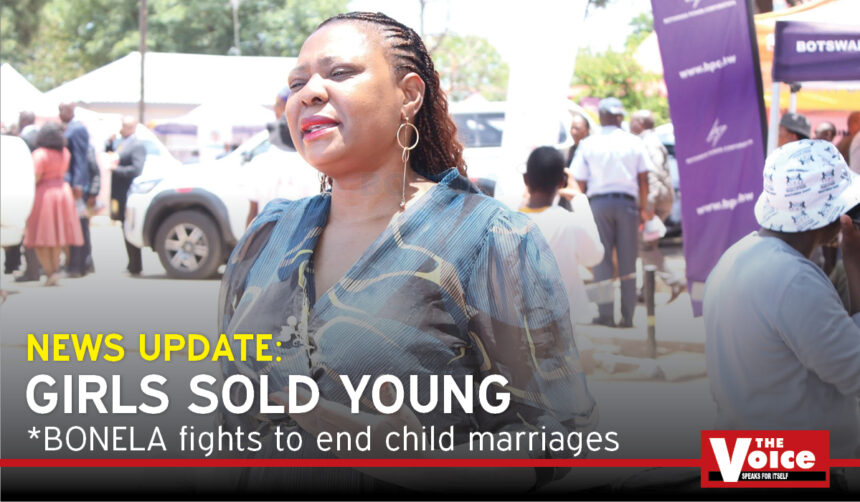
*BONELA fights to end child marriages
Child marriages in some local communities have attracted global attention, with underage girls who are still being married off, divorced, widowed, or caught in informal unions.
Human rights organisation, Botswana Network on Ethics, Law and HIV/AIDS (BONELA) has corroborated findings by global think tanks indicating that families are signing off underage girls for marriage.
A rapid assessment that BONELA undertook in three regions in Botswana, linked cultural and religious beliefs among Bazezuru, Basarwa and Ovabanderu to the perpetuation of child marriages.
Ovabanderu and Basarwa communities are not denying the existence of child marriages, but they argue that the cases are isolated.
The Voice has obtained data from Statistics Botswana showing that children are dropping out of junior and senior secondary school as a result of marriage solemnisation.

BONELA Director, Cindy Kelemi agrees with Social Institutions and Gender Index (SIGI) that child marriage remains a significant child protection, gender equality and human rights concern in Botswana.
“BONELA’s rapid assessment conducted in Boteti and Ngamiland found that child marriages continue to occur among some communities and ethnic groups,” said Kelemi.
Through BONELA interventions, Kelemi noted that the organisation was able to halt a child marriage in 2022 in Ngamiland.

She stated that through their assessment they found out that girls in child marriages are exposed to early pregnancy, sexually transmitted infections, HIV, gender-based violence, emotional abuse, depression and other mental health challenges.
Through the assessment, Kelemi stated that the respondents reported that some cultural and religious practices perpetuate child marriage through arranged unions, child betrothal and practices such as ‘Peo Letlhokwa’, where a child is identified for marriage at a young age.
A report published by global think tank SIGI last year indicates that 13% of girls aged 15-19 were or are still married, divorced, widowed or in an informal union in Botswana.
Participants reported that girls are sometimes married off after failing Form 3, while poverty, harmful cultural practices, religious beliefs and weak reporting mechanisms continue to drive the practice.
She said that the assessment established that child marriage violates children’s rights to education, bodily autonomy and integrity, health, leisure and development.
“Girls in child marriages are exposed to early pregnancy, sexually transmitted infections, HIV, gender-based violence, emotional abuse, depression and other mental health challenges,” said Kelemi.

She further stated that data from Statistics Botswana showing children who are dropping out of school is just a tip-of an iceberg.
Kelemi noted that many cases remain hidden because families fear victimisation, cultural backlash or exposing relatives involved in the arrangements.
She called for stronger legal protections by removing loopholes that permit child marriage, intensifying implementation of the Children’s Act, empowering communities to report cases and increasing economic empowerment programmes for vulnerable families.
“Community leaders, dikgosi, faith leaders, schools and civil society must work together to create zero tolerance for child marriage,” added Kelemi.
BONELA has been at the forefront of advocacy through the “My Body is Not a Democracy: Supporting National Advocacy on Bodily Autonomy and Integrity (BAI) in Botswana” project.
Through BONELA campaign against child marriage the organisation was able to track and stop one child marriage from occurring in Ngamiland in 2022.
Kelemi expressed concern that while Botswana has made progress through the Children’s Act, the existence of exceptions creates confusion and weakens enforcement.
She said that through the assessment they have recommended for the removal of legal provisions that permit parental consent for underage marriages.
“Children cannot meaningfully consent to marriage, and the law should prioritise their protection, education, health and development,” Kelemi added.
While the Children’s Act prohibits forced marriage, child betrothal and harmful cultural practices, BONELA argues that implementation and enforcement remain critical challenges.
Meanwhile, Ovabanderu Traditional Authority Steering Committee Member, Rikoruavi Hengari acknowledges that child marriage exists in isolated cases, but insists it is no longer widely accepted.
He said that currently child marriage which was normalised in the 80’s and 90’s has largely disappeared from the community.
“Thetre may still be isolated cases in rural areas, but people are aware that there is a possibility of facing criminal charges for defilement,” he said.
Hengari indicated that for a long time the Ovambanderu Youth Association of Botswana took a stance not to support child marriage.
He said that in cases where there is arranged marriage, those individuals are required to reach the age of consent and they also have an option to make their own choice.
Botswana Khwedom Council Human Right Activist, Banyatsi Salutu also admitted that child marriages exist among the Basarwa communities.
He however said that the council was against the practice and that they are in full support of BONELA’s call to end child marriages in across the country.