


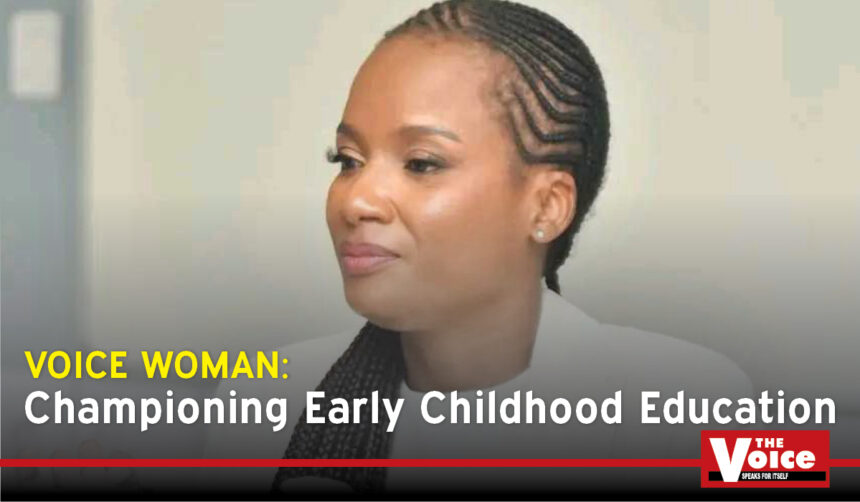
Educator, entrepreneur, and researcher in early childhood education, Kagiso Pearl Kgosiemang, has built a reputation as a passionate advocate for literacy, language development and quality learning, challenging long-held assumptions about how young children should be taught.
She began her journey as a secondary school teacher after earning a Bachelor of Education in Physical Education, later working in South Africa before returning home in 2015, only to be confronted by the sobering rise of unemployment, an adversity that would completely change her career trajectory.
The mother of two’s passion for education saw her graciously return to teaching the alphabet to a new generation.
“It was a Montessori institution in Tlokweng; the only one in Botswana offering a specialised curriculum recognised in America and other developed nations. Typically, Montessori teachers must be trained and licensed, which I was not; however, an exception was made for me, and I thoroughly enjoyed my time there,” she reflects, adding that the nursery floor is a peaceful place where learning truly begins.
Drawing on her experience as a secondary school teacher accustomed to working with older students, Kgosiemang found the transition particularly enlightening.

“I had often witnessed adolescents grappling with foundational concepts. However, when I began teaching younger children, it became apparent that with clear instruction and dedicated training, they could grasp new ideas more readily, which allowed me to lay a robust foundation during their formative years,” she explains in this intellectually stimulating conversation with Voice Woman.
Indeed, this return to first principles inspired Kgosiemang’s commitment to early childhood education (ECE) and literacy development in Botswana, a decision that culminated in her registering a company several months later, cleverly choosing her birthday for the milestone.
“On July 14 th , 2015, I registered Jouerhall (jouer is French for ‘play’) as an after-school programme that also offered babysitting services. But starting the JouerHall Language and Literacy Assessment Centre wasn’t smooth.
When I approached local authorities seeking the necessary licences to operate, I was met with confusion. Officials informed me that no licensing category existed for the type of service I intended to provide. My lawyer assured me that as long as I registered with CIPA and paid my taxes, I would be compliant,” recalls the self-described go-getter.
But the challenges did not end there. Until 2017, her business became the target of repeated visits from Gaborone City Council officials threatening closure, a classic catch-22, considering they demanded a licence they themselves could not provide.
Undeterred, the bureaucracy fuelled her interest in education policy and reform. “With my BA, I didn’t know much about children,” she admits.
Thus, she enrolled in a master’s degree in Primary Education and fully immersed herself in research on early childhood policy. What she discovered was deeply concerning. According to Kgosiemang, the education system continues to rely heavily on an early childhood policy developed more than two decades ago. “The policy is silent on many critical issues,” she says.
“It lacks standardised requirements for preschool operators. Under the current framework, anyone can establish a preschool with minimal educational qualifications and design their own curricula for approval by local authorities. If every other level of education is subjected to quality assurance and accreditation, why should early childhood education be any different?” she asks rhetorically.
Perhaps Kgosiemang’s most controversial position is her belief that many modern preschools may be doing more harm than good.

“If I had known what I know now, I would not have sent my children to preschool,” she says bluntly, adding that most of the topics included in local preschool curricula are not important.
Her criticism is not directed at the concept of early learning itself, but at what she sees as the increasing formalisation of preschool education. According to Kgosiemang, many centres place excessive emphasis on academic tasks while neglecting the natural developmental needs of young children.
“They are expected to sit quietly, stay still, and behave like older learners. But that’s not how young children learn,” she says.
Instead, she advocates for environments that prioritise interaction, exploration, play, and communication.
At the heart of her concerns lies one issue above all others: language development. She says 15% of children globally have language developmental delays and that there are currently no interventions across schools.
“In fact, children raised at home by grandparents are better off because language development – which is my area of interest – is not neglected. Language, both receptive and expressive, is developed through interactions,” she asserts, adding that many educational environments overlook the importance of helping children develop strong expressive language skills.
For Kgosiemang, language development is not just another educational topic; it is the base upon which all future learning is built.
“A child cannot write if they cannot speak,” she explains. “Before anything can be written on paper, it must first exist in the mind. While children may spend hours in classrooms, they often have limited opportunities to engage in meaningful conversations.”

Her concerns mirror a growing international conversation about developmental delays among young children, particularly in the aftermath of increased screen exposure and reduced social interaction.
One of the strongest warnings Kgosiemang issues is directed at modern parenting habits.
In many households, she says, electronic devices have become substitutes for human interaction.
“Parents are busy. Children are handed tablets. Television fills the silence. But language develops through relationships, not screens. We think we are busy, but often we are neglecting interaction,” she says.
The consequences, she warns, can emerge surprisingly early. She draws an important distinction between speech delays and language delays.
“Speech delays involve difficulties producing sounds, while language delays affect a child’s ability to understand, organise, and communicate thoughts.”
Kgosiemang believes Botswana needs a serious national conversation about the purpose of early childhood education and whether current practices are truly serving children’s developmental needs.
That conviction prompted her to write to President Duma Gideon Boko shortly after completing her master’s degree last October.
“Remember the President said Batswana may help with solutions, so I wrote an open letter to play my part, especially since he clearly loves children and education,” she says.
Titled ‘Advocacy for the Strengthening of Early Childhood Education (ECE) in Botswana through Quality-Assured Best Practices and Innovations’, the letter called for urgent reforms to the country’s early childhood education framework.
“While the ECCE Policy of 2001 was progressive for its time, the cracks have now started emerging as it presents several challenges. For example, allowing preschool owners to design their own curriculum without requiring formal training in curriculum development or ECE fundamentals has led to widespread inconsistencies in quality. Furthermore, the policy is silent on child development, a core element in understanding how young citizens grow and learn during their most formative years. There is a need to address the glaring errors of policy and customise it to accommodate DAPs in order to achieve the holistic development of children through ECE,” the letter states.
Today, with more than 28,000 social media followers and as a PhD candidate, Kgosiemang continues to advocate for improved childcare, literacy, and language development.
Through Jouerhall, she champions the belief that literacy begins early.
Based in Block 7 and Phase 2, Jouerhall combines psychological assessments, specialised literacy programs, and hands-on activities to bridge reading gaps and foster well-rounded development for every child.