


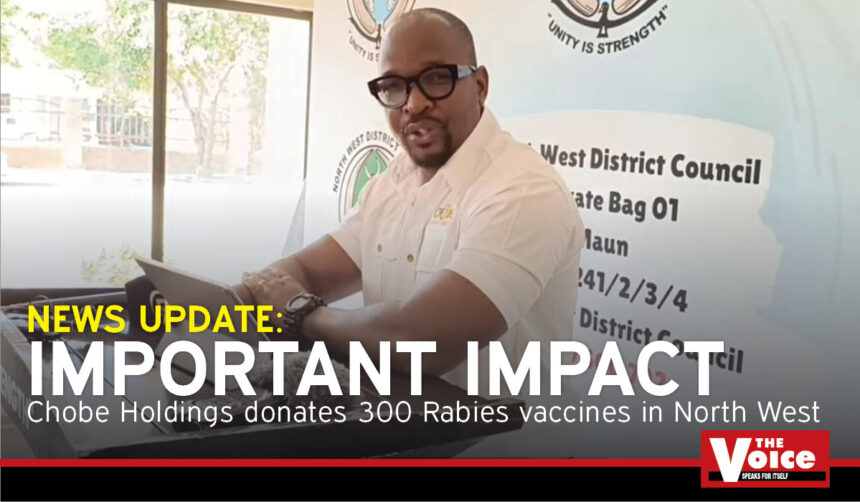
Chobe Holdings donates 300 Rabies vaccines in North West
Living up to its ‘Chobe Impact’ title, tourism giant Chobe Holdings’ philanthropic arm has donated 300 rabies vaccines valued at P50,000 to the North West District Council (NWDC).
The official handover took place in Maun last Monday, led by Chobe Holdings Managing Director, Lempheditse Odumetse.
The donation comes at a critical time for the region, which is grappling with a deadly rabies outbreak and a critical shortage of essential medical supplies.
Speaking at the event, Odumetse did not shy away from the harsh realities facing the country’s healthcare system, whereby a preventable disease is now a killer difficult to contain.
“Communities have been rattled by rabies; we have lost lives. The golden days are not here anymore. The hospital shelves and pharmacies are empty. When the reality of this hit us very hard as a country, Chobe decided to step in to make a difference.”
Odumetse explained the gesture aligns perfectly with the company’s core corporate social responsibility values.
“In our business, we run on three pillars: investing in wildlife, investing in people, and investing in Batswana. What we are demonstrating today is in line with that mandate,” he declared.
The North West District, particularly the tourism hub of Maun and surrounding Ngamiland villages, has seen a terrifying spike in rabies cases recently.

The crisis has already claimed the lives of four young girls in Maun, all under the age of 10, who succumbed to the virus following dog bites.
Odumetse noted that while rabies is entirely avoidable, the country’s current economic constraints have left it vulnerable.
“We are just sitting in a position where we cannot afford to fight a simple disease because we are financially strapped. I would like to call upon my colleagues in the business industry to come forward and support these efforts to protect lives and prevent further deaths,” he urged.
While Odumetse characterised the P50, 000 contribution as a ‘small donation’, local authorities emphasised that its impact will be ‘monumental’.
NWDC Council Chairperson, Itumeleng Kelebetseng, revealed the local authority had been forced to plead with the business community for assistance as dog bite cases continued to escalate across the Maun area. He praised Chobe Holdings for answering the call.
Kelebetseng closed the ceremony with an urgent plea to the public, imploring parents to take dog bite victims to health facilities immediately.

“Because rabies is incurable once symptoms appear, immediate post-exposure prophylaxis (PEP) vaccination is the only way to save a victim’s life,” he said.
Rabies is a highly fatal but 100 percent preventable viral disease, usually transmitted through the bite of an infected animal. In Maun, the issue is compounded by a high population of stray dogs roaming residential areas and the edges of wildlife zones. Compounding the tragedy, Botswana’s public health sector faces an acute shortage of vaccines and medications, leaving clinics ill-equipped to handle the influx of dog bite victims.
The crisis is underscored by alarming data as of May 2026, which details 87 official dog bite cases recorded across the district, with 32 patients receiving emergency treatment for direct rabies exposure.
The biological severity is further proven by the fact that 22 out of 25 suspected dogs tested positive for the virus. The highest concentration of these stray dog attacks and positive cases has been documented in public spaces across key Maun wards, specifically Boseja, Moeti, Newtown and Boyei, triggering an aggressive multi-agency response.
To curb the spread, joint operations by the local council, police, bye-law enforcement, and the Animal Welfare Society have already resulted in the euthanasia of over 200 stray or uncontained dogs, while ongoing door-to-door containment and inoculation efforts by veterinary teams have reportedly pushed local animal vaccination coverage to 72 percent.