



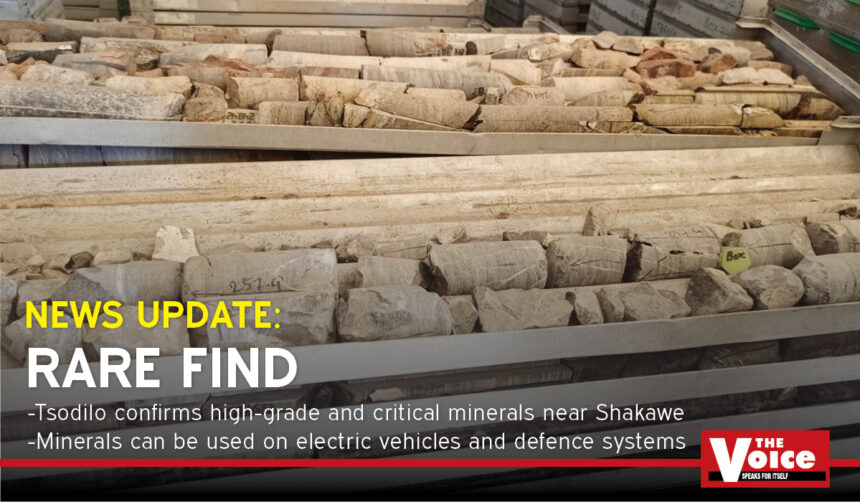
-Tsodilo confirms high-grade and critical minerals near Shakawe
-Minerals can be used on electric vehicles and defence systems
Canadian mineral exploration company, Tsodilo Resources Limited, has confirmed the presence of significant rare earth element (REEs) and critical minerals at its wholly owned Gchwihaba Metals project near Shakawe in North West Botswana.
In its January 2026 press statement, the company indicates that the discovery, which follows systematic exploration of the C26 and C27 targets, confirms a high-grade polymetallic system located just 20 to 50 meters below the surface.
The company reported that the deposits include 15 rare earth elements and five other critical minerals, specifically copper, cobalt, nickel, vanadium, and silver.
“The targets were originally identified as geophysical anomalies through ground magnetic and gravity surveys. Subsequent diamond core drilling has confirmed that these anomalies host skarn-type mineralization containing an extensive suite of minerals,” reads the statement in part.
The technical analysis of the C26 and C27 skarns shows that they contain all 15 rare earth elements currently listed on the U.S. Geological Survey’s 2025 List of Critical Minerals.

Notably, the neodymium-praseodymium (NdPr) content at Gchwihaba represents approximately 15% of the total rare earth oxides.
This ratio according to the company is comparable to the 15.7% NdPr content found at the Mountain Pass Mine in the United States, a benchmark for high-performance permanent magnet materials used in electric vehicles, wind turbines, and defense systems.
The company further maintains it has established a conceptual exploration target for the project ranging from 81 to 97 million tonnes, with grades between 0.005% and 1.49% total rare earth oxides. This target area they say extends across a four-kilometer strike length.

“The 1.49% TREO intercept at C27 represents the highest grade recorded so far for Gchwihaba,” stated James M. Bruchs, Chairman and CEO of the company.
“These results validate our systematic exploration approach and demonstrate evidence of a ploymetallic REE skarn system with both vertical extent and grade. Our conceptual exploration target of 81 to 97 million tonnes was generated through integrated magnetic and geological modelling using a ground magnetic inversion model, constrained by drilling results and geological interpretation. This modelling was completed in-house using paradigm GOCAD software. Beyond rare earth elements, the skarn contains cobalt up to 320 ppm and silver up to 5.1 g/t in the C27 skarn. The 2026 drilling program will focus on defining high-grade REE zones while further evaluating the polymetallic potential of the system to support preparation of an initial mineral resource estimate.”
To date, Tsodilo maintains, it has completed twelve exploration drill holes totaling 3,303 meters at the site. Geochemical analysis of 1,612 diamond core samples showed that 76% of the samples returned detectable mineralization.
“This represents the first systematic assessment of REE potential at the Gchwihaba Metals Project,” Bruchs noted. “The company has completed twelve NQ size exploration drill holes totalling 3303 metres to date across the C26 and C27 skarn targets. A total of 1,612 diamond core samples from nine drill holes were analysed for multi element geochemistry, with 1 224 samples (76%) returning detectable REE mineralisation. Four drill holes returned high-grade TREE intercepts up to 1.49% TREO at the C27 skarn anomaly.”
The mineralogy identified at the site includes carbonates such as bastnäsite and ancylite, silicates like allanite and britholite, and phosphates including monazite and xenotime. Experts note that this assemblage is typical of skarn-hosted rare earth deposits globally, which generally feature well-established extraction methods.
Looking ahead, Tsodilo plans to launch a 15,000-meter drilling program in 2026. This campaign will consist of approximately 50 drill holes designed to define high-grade zones and provide the data necessary to produce a compliant NI 43-101 mineral resource statement.