




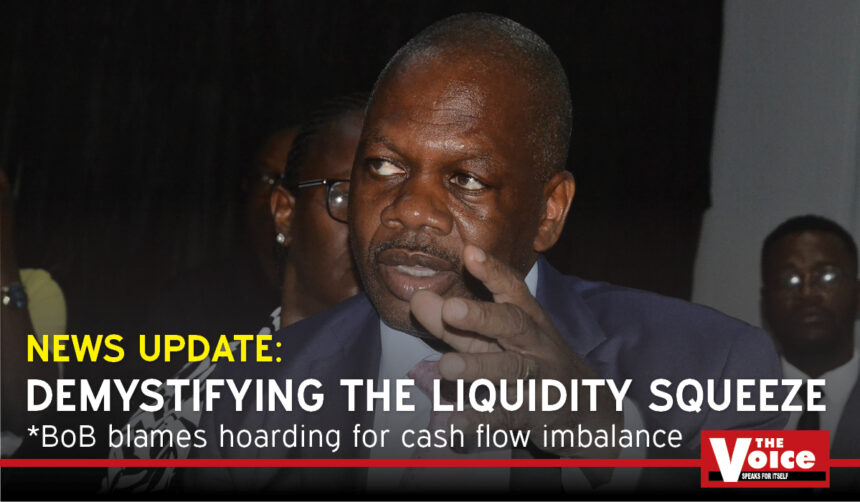
*BoB blames hoarding for cash flow imbalance
The Bank of Botswana (BoB) has dismissed the current liquidity squeeze in the financial sector as a man-made problem that requires targeted intervention to restore normalcy.
Speaking at a Monetary Policy training for business reporters in Francistown this week, senior management from the Central Bank reiterated that the healthy annual returns declared by various banking institutions indicate that the financial sector remains robust and profitable.
Hosted by the newly appointed Governor Lesego Moseki, the workshop was meant to drill journalists on the duties and objectives of the Monetary Policy Committee.
According to Principal Economist in the Research and Financial Stability Department, Bokhana Motshewa, this demonstrates that Batswana continue to take up and service loans.
Motshewa said the liquidity squeeze is partly due to government no longer injecting as much money into the economy as it previously did.

“Remember, the biggest driver of the economy has always been the government. But with the current economic situation, government’s liquidity is not the same,” she said.
She further highlighted that non-performing loans currently stand at 3.5%, a level considered healthy.
“If non-performing loans were to balloon to around 15%, then we would have a serious problem,” she warned.

In his presentation, Senior Economist in the Research and Financial Stability Department, Dr. Lesego Molefhe, said the biggest challenge the country faces is the redistribution of funds. He explained that the liquidity difficulties stem from hoarding by some financial institutions, which disrupts overall cash flow.
“The liquidity is there; the problem is redistribution. Funds may be concentrated in one or two banks, which has forced other banks to repeatedly access the Standing Credit Facility to manage their liquidity,” he said.
Molefhe added that after observing increased borrowing by commercial banks from the Central Bank, BoB introduced interventions by implementing targeted liquidity support measures to address tight domestic liquidity conditions.
These measures include longer-term repo operations, a pause in prime lending rate (PLR) increases, and efforts to improve foreign exchange market functioning.
He said since the introduction of these interventions, the Bank has observed greater uptake of longer-tenure instruments and more active interbank foreign exchange trading.
“Commercial banks are no longer coming to us for foreign currency; they are using what they have,” Molefhe said.

He noted that the adjustment of the exchange rate policy parameters in July also contributed to stabilizing foreign exchange reserves, anchoring the Pula’s external value, and increasing interbank foreign exchange market activity from an average of P2.4 billion to about P3 billion per month.
“This means the Central Bank’s foreign exchange sales have also reduced from approximately P4 billion to P2.8 billion per month,” he said.
Molefhe, however, cautioned that these positive developments can only be maintained through stronger fiscal policy responses and greater economic diversification.
“We believe that even when diamond sales bounce back, they will never reach the levels they used to,” he said.