




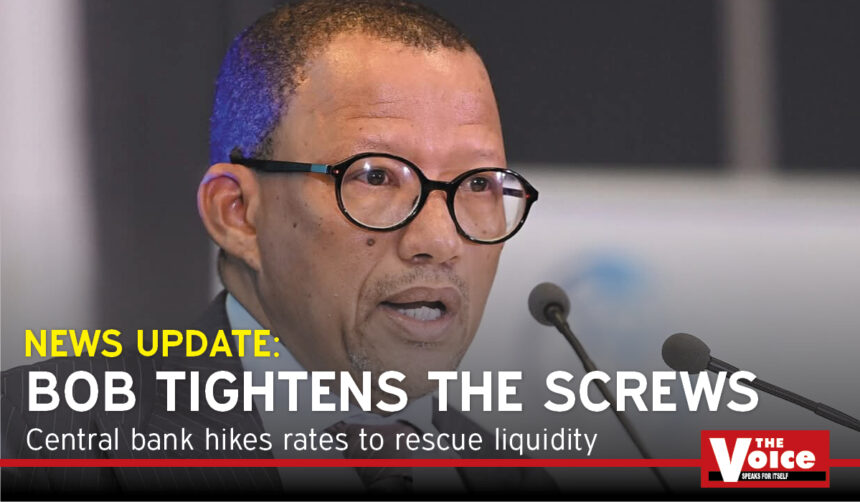
*Central bank hikes rates to rescue liquidity
In a bid to narrow the widening gap between its policy rate and higher lending rates charged by commercial banks, Bank of Botswana (BoB) has raised its main interest rate by 160 basis points amid a liquidity squeeze and economic slump.
The move follows a second consecutive year of economic contraction as weak global demand for diamonds continues to weigh on Botswana’s growth and liquidity. The decision takes Botswana’s Monetary Policy Rate to 3.5% up from the previous1.9%. By lifting the policy rate to 3.5% BoB aims to realign the policy corridor and anchor market rates to improve liquidity management.
Though the economy contracted last year, it is still expected to do so again this year due to prolonged downturn in the global market for diamonds, the key export. Banks have been raising their lending rates as liquidity has dried up because of lower diamond sales and increased government borrowing to cover the budget deficit.
According to BoB governor Cornelius Dekop the rate hike should improve monetary policy transmission. “This has been influenced by the need to realign with rates trending in the market. We have also ordered banks not to increase their prime lending rates further. This together with other initiatives will help the liquidity situation that has seen interest rates rise in the economy as well as depletion of foreign currency reserves,” said Dekop.
However, the move comes with risks: higher borrowing costs could further constrain investment and consumer spending in an already contracting economy. The instruction to freeze prime lending rates signals the central bank’s effort to protect borrowers while recalibrating policy transmission. With inflation inching higher and credit conditions tightening, Botswana’s economic outlook hinges on a recovery in global diamond demand and prudent fiscal adjustments to stabilise debt and support diversification beyond the mining sector.

This month credit rating agency Moody’s downgraded Botswana’s sovereign rating, citing the government’s difficulties adjusting to the downturn in the global diamond industry and increasing government debt. Botswana’s aggressive rate hike underscores the central bank’s attempt to reassert monetary control amid deteriorating fiscal and external conditions. The diamond slump has exposed the country’s dependence on its flagship export, eroding revenues and tightening credit across the financial system.
Meanwhile, inflation accelerated to 3.7% year-on-year in September from 1.4% in August, still within the central bank’s 3-6% target range. Nonetheless, this is its highest level in more than a year, according to new data from Statistics Botswana. As a result, BoB now forecasts inflation will rise from an average of 2.7% this year to 5.9% next year.
The rate jump is driven primarily by higher fuel and food prices following a weakening of the pula after July’s exchange rate adjustments. Fuel prices rose by an average of P1.60 per litre, while food costs continued to climb as producers and retailers adjusted prices across the supply chain. Food inflation reached 5.4% in September, up from 5% in August, increasing pressure on household budgets. Botswana’s latest inflation spike reflects the country’s growing exposure to currency and import-price shocks, with the pula’s depreciation feeding directly into higher fuel and food costs.
While inflation remains within the BoB’s medium-term target range, the recent surge underscores the fragility of price stability amid external pressures. Rising living costs threaten to erode household purchasing power, particularly for low-income consumers, and could slow consumption growth.