



Botswana braces for limited impact as US trade deal expires
The Africa Growth Opportunity Act (AGOA) may not have played a significant role in Botswana’s industrialisation, but its impending lapse next Tuesday (September 30th) is raising concern about what the future holds.
With AGOA coming to end on September 30, 2025, the likelihood of the Act being renewed is low given recent US international policy shifts.
In an interview with Voice Money, economist Sennye Obuseng explained that while Botswana’s direct exposure under AGOA has been minimal, the US market remains too lucrative to dismiss. Losing access to it, Obuseng says, carries broader implications for Botswana’s long term growth.
“Our industrialisation plans for the future require access to rich markets, and the US is one such. Therefore, the impact of its lapse on industrialisation will not be huge. It will certainly be nowhere close to the likely scale of impact on Lesotho’s textile and apparel sector,” Sennye opined.
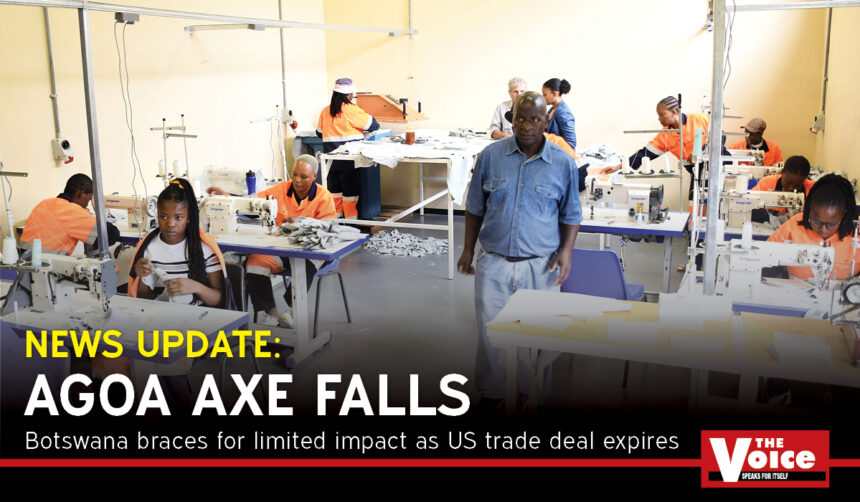
Once a key beneficiary under AGOA, Obuseng says, Botswana’s textile and apparel sector has in recent years dwindled significantly.

“My view is that the lapse of AGOA will hurt our efforts at industrialisation but in aggregate terms, it will not be by much. To firms that were set up to exploit AGOA and have not diversified their markets, the lapse of AGOA is an existential threat. However, overall, the loss for Botswana lies more in the future lost potential the US provides than historical exports to the US,” said Obuseng adding that for Africa as a whole, the loss of AGOA will be a major economic setback.

According to Obuseng, with or without AGOA, Africa needs to review its development strategies with boosting intra-Africa trade envisaged by the African Continental Free Trade Area (AfCFTA) as the game changer. “Africa must accelerate the policy reforms required by the AfCFTA, not only to boost intra-Africa trade but also to boost trade with the rest of the world. Policy convergence is critical, as are investments in regional public goods, in particular infrastructure that supports investment and trade, and cooperation on knowledge creation,” he added.
In April 2025, the US government imposed reciprocal tariffs on many countries, effectively overshadowing AGOA. Prior to that, the US had abruptly cut aid to Africa, making it clear that developmental concessions like AGOA were no longer on the table.

“At the aggregate level, the loss of AGOA will hurt but not by much in monetary terms. The loss of AGOA is mostly because of the potential the US market offers. AGOA offered us the best prospects for growth into that rich market,” said Obuseng adding that the loss of AGOA could create significant macroeconomic problems for a lot of countries, including slowdown in growth, rising unemployment and poverty, current account deficits and foreign exchange problems.
Botswana has benefited from AGOA, though not as much as countries like South Africa, Nigeria, Ghana and Angola. However over the years, Botswana has seen exports to the US under the act decline to zero value from P300 million in 2007.
The last shipping of goods under AGOA from Botswana was in 2017 worth just a mere P10 million.
“The loss of AGOA should not significantly affect our plans to move up value chains. The rest of the world, including China, India and an integrated Africa under the AfCFTA are sufficient to support Botswana’s manufacturing ambitions. The challenge remains one of whether Botswana can master the levels of productivity and competitiveness necessary to penetrate global markets,” said Obuseng indicating that with AGOA expiry, African trade will shift to other markets such as Europe, Eurasia and China.
With close to 39 African countries eligible for AGOA, nations like South Africa, Nigeria, Lesotho and Madagascar, have very high exposure to the US market.
Therefore the elapse of AGOA means industries will collapse and millions of jobs will be lost if the act comes to an end next week as expected.

Lesotho’s textile industry is one of the major AGOA success stories and is bound to collapse.