



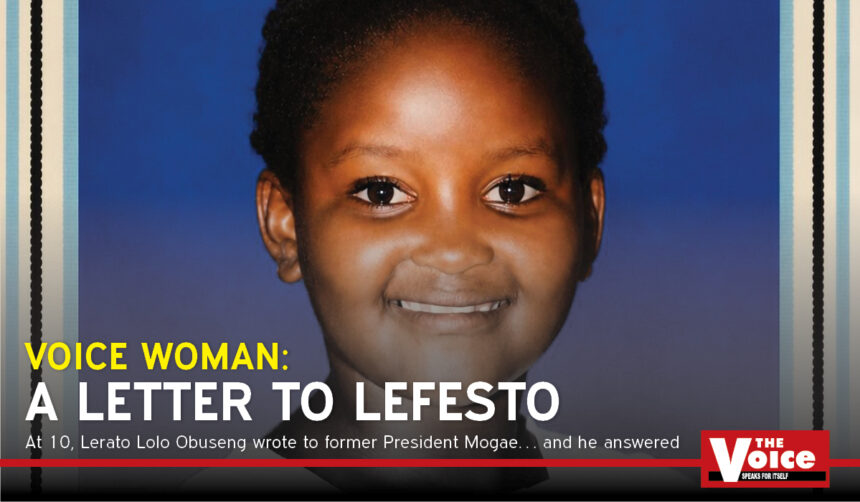
At 10, Lerato Lolo Obuseng wrote to former President Mogae… and he answered
In 2004, six years into his presidency, Botswana’s third President, Festus Gontebanye Mogae received an unusual letter from 10-year-old Lorato Lolo Obuseng.
True to his consistent salt-of-the-earth nature – a trait emphasised in anecdotes shared by various speakers during his recent sendoff – Mogae wrote back.
22 years later, Obuseng shared that letter publicly, not only to honour the esteemed Rra Nametsos’ memory, but to remind Batswana what leadership can look like.
Now 32, the Gaborone-born Obuseng lives in London, where she works as an AI Strategy and Automation Specialist at CommCore AI.
She is also co-founder of Share My Story Botswana and Diphalane Breakfast Sessions, initiatives focused on connection, leadership and community dialogue.

But once, she was simply a frightened child.
At the time, the country had been shaken by the murder of 10-year-old Kgotso Macfallen in Francistown, a little girl strangled to death by her father who sought to evade child maintenance.
Even though she was schooling in Tlokweng by then, the story deeply unsettled the lass, whose own parents were separated.

“During that week, I would often overhear my mother speaking with her friends about a little girl who had been murdered by her father,” she narrates, adding it was the chilling reason behind the gruesome crime that disturbed her.
“Like that child, I, too, came from a family where my parents had separated. Similarly, I was also collected from school, and I was that girl’s age.
That story was not abstract, it felt like my life with a different ending,” Obuseng recalls.
She did what made sense to a 10-year-old. Alone after school, she penned a letter to the president, sealed it and mailed it unbeknown to anyone, even her mother.
“I didn’t write to challenge President Mogae; I wrote because I trusted him as a leader to act. I did what I had been taught and went to the highest authority I could think of. I told him that children were not safe; that I was afraid and that something had to be done,” she recounts.
A Standard4 student at St. Mary’s Primary School, Obuseng admits never in her wildest dreams did she expect a reply.

“Simply sending it was enough for me; it meant I had spoken up. I had shared what was on my heart with my country’s president,” she explains.
She was in for a surprise.
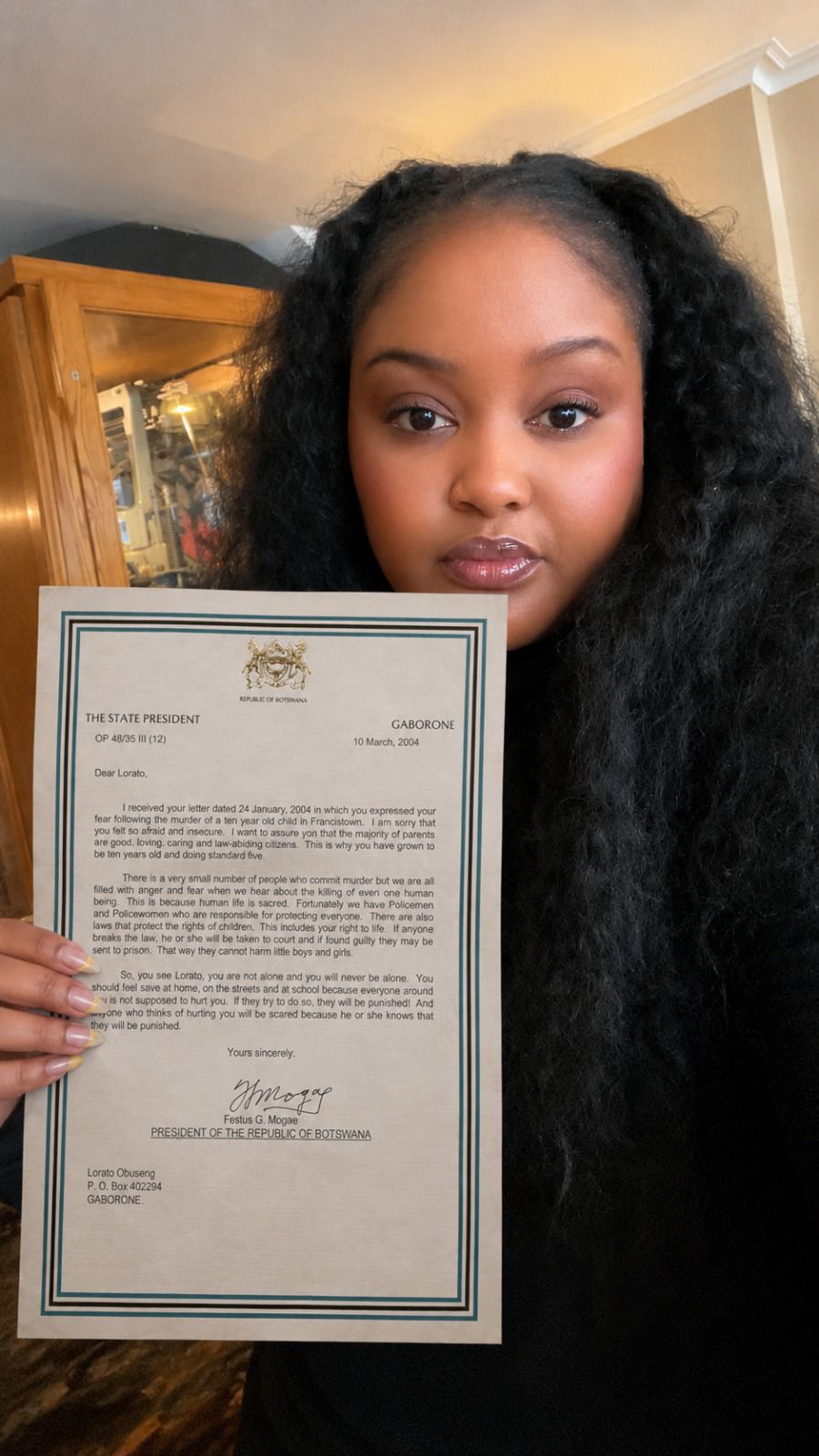
“What happened afterward was beyond my control. In a curious way, that kind of civic engagement feels the most genuine; free from any expectation of reward. I didn’t write for acknowledgment or because I believed it would make a difference. I wrote because remaining silent felt like betraying that little girl in Francistown… it felt like betraying myself!”
Weeks later, her mother, Margaret, arrived home carrying a large envelope from the post office. It bore the presidential seal.
“She looked at me and asked nervously, ‘Why has the president written you a letter?’” Obuseng remembers with a giggle, adding, “That’s when I finally told her what I had done.”
Her mother was overwhelmed with pride. In Tonota, her grandmother shared the story with anyone who would listen.
At the time, Obuseng did not fully grasp the significance of what had happened. That understanding came years later.
“It meant I had been heard. To a child, that is everything; I just remember everyone telling me that I should be proud of myself.”
The late leader’s response was personal and reassuring. He addressed her fears directly, explained that the law existed to protect children, and assured her that Botswana cared.
“He didn’t send a generic response; instead, it was a measured reply, using simple language and thoughtfulness so I could understand,” she recounts, adding the reply felt surreal.
Ultimately, justice did indeed take its course; Macfallen’s father, Kedisaletse Tsobane, a driver for the city council, was found guilty and sentenced to death; he was hung in 2017.
While the two never met, after Mogae’s passing, Obuseng found herself revisiting the letter.
“I started reflecting on everything he was dealing with at the time: the AIDS crisis, the pressure of leading the country…and yet, in the middle of all that, he took time to respond to a frightened little girl from Tonota,” she says, noting this thoughtful gesture revealed the true measure of the man.
Looking back, Obuseng sees the letter as a defining moment in shaping her life’s work.
“Everything I have since built is based on the notion that ordinary people deserve to be heard. That letter became the blueprint.”
That blueprint saw Obuseng co-found ‘Share My Story Botswana’ and ‘Diphalane Breakfast Sessions’ in 2018 and 2019 respectively.
“That simple yet profound act of being heard became the reason I have spent my adult life creating spaces where young people feel seen, valued and connected. Every person who leaves one of our gatherings feeling less alone; that is me answering the late former president’s letter,” she says, explaining she shared the exchange publicly to remember not only his policies and achievements, but his humanity.
“He deserves to be remembered for this, too; the quiet, fatherly thing he did for a child who would never make the news!” – not until this week on the best-selling paper in the land that is!
Obuseng hopes the story reminds Batswana of the values that have long defined the country.
“We are in a difficult season. But this letter reminds us who we are, a people who show up for each other, from the highest office to the smallest village,” she insists.
The public’s response has been emotional.
Many have shared stories of moments when they, too, felt seen or ignored by leaders.
For Obuseng, the reaction confirms something she strongly believes: leadership is not only about policy or power, but presence.
“President Mogae understood that people are not a crowd. They are individuals carrying specific fears, burdens and hopes,” she says.
If she could speak to him one last time, her message would be simple, “Ke itumetse, Rra. Thank you not only for your service to Botswana, but for taking the time to read a letter from a little girl and answering her with kindness. The girl you wrote to became a woman trying, in her own way, to write back to her country every day. Rest well, Rraarona.”