




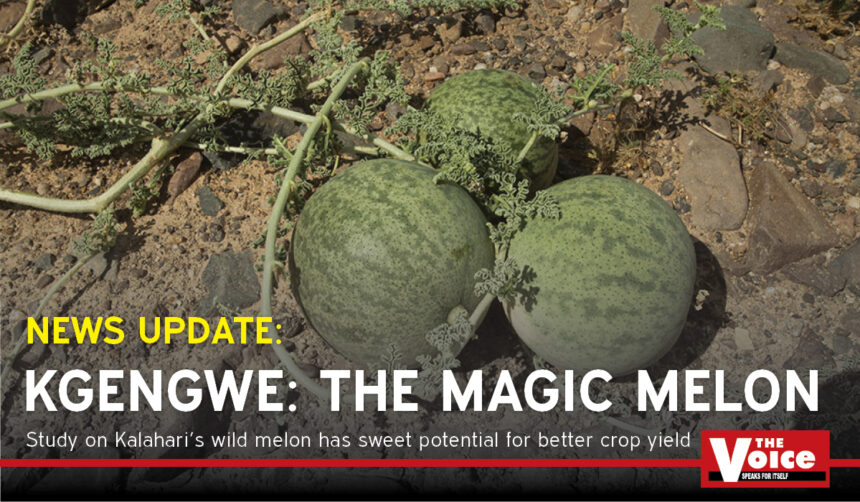
Study on Kalahari’s wild melon has sweet potential for better crop yield
Scientists from the Botswana University of Agriculture and Natural Resources (BUAN) have conducted groundbreaking research on the wild melon (kgengwe/citrullus lanatus), a water-rich fruit native to the Kalahari Desert.
The study, published in the Journal of Agriculture Science on 15 May, looks at how the wild melon’s properties can be used to produce a super melon able to withstand the harsh local climate.
The findings offer valuable insight into how the wild watermelon can be used as a rootstock in grafting its susceptible relatives to mitigate drought stress and increase watermelon yields.
With climate change posing a serious threat to crop output due to significant changes in temperatures and rainfall, the highly sensitive watermelon is one of the most vulnerable crops.
According to the exploration led by Dr Rosemary Kabue Lekalake and Dr Goitseone Malambane, grafted watermelon showed a noticeable decline in stomatal conductance [a measure of how easily gases (like CO2 in and water vapor) move through the tiny pores (stomata) on a plant’s leaves] compared to cultivated watermelons.

By closing their leaf stomata quicker than their planted cousins, the wild melons displayed a drought avoidance mechanism.
The research further showed that wild watermelons flowered and matured earlier than all cultivars, indicative of a drought escape mechanism that can be harnessed and incorporated into grafting for breeding.
In terms of yields, grafted watermelons produced more fruits with higher weight than cultivated watermelon, indicating increased rooting capacity, making them more efficient in absorbing water and nutrients, resulting in larger fruit sizes and better overall yields.

Most importantly, grafting did not affect the quality of watermelon solutes.
The researchers believe that since kgengwe grows naturally in the harshest environments of the Kalahari Desert and possesses high tolerance for both biotic and abiotic stress, it has the potential to contribute to crop diversification and improvement.
“It exhibits exceedingly high tolerance to drought and excess light stress; even in extreme drought, it maintains its water content, preventing any withering of the leaves or desiccation,” they noted.
A Research Assistant currently pursuing her PHD in Food Science and Technology at BUAN, Ompelege Matenanga is one of the few working on climate smart crops such as kgengwe for cultivation, value addition and marketing to improve food security in the country.
“Climate change is real, but our indigenous plants survive these harsh conditions. It’s about time we use what we have to assist subsistence farmer,” she said.
“Production in the farms is low, but plants like morama and kgengwe are thriving despite the heat and little rain,” she added.

Matenanga is involved in community upliftment initiatives, teaching women in remotes areas like Kaudwane and Shaikarawe to use natural resources to earn a decent living.
“Studies have been conducted, so we go out and teach these women to make kgengwe jam, sweets, juice, or how to extract oil from mongongo tree nut,” she revealed, adding some of the women have been taken for intensive training at the National Agricultural Research and Development Institute (NARDI).
“Our communities now know that indigenous plants are important and valuable, and know the dangers of over harvesting,” Matenanga said.