




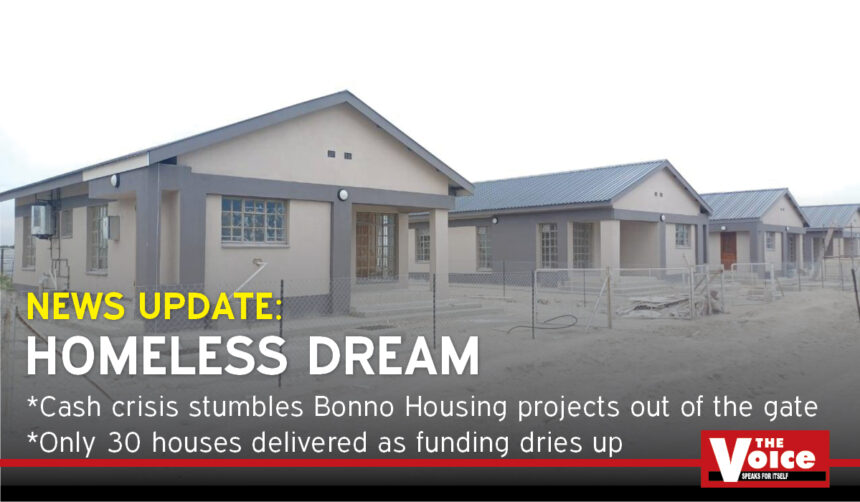
*Cash crisis stumbles Bonno Housing projects out of the gate
*Only 30 houses delivered as funding dries up
The highly anticipated Bonno Housing Scheme Turnkey project has got off to a poor start, weighed down by severe cash-flow challenges.
Of the 295 housing units planned for the 2025/26 financial year only 58 have been started, with a mere 30 completed and handed over to beneficiaries.
The Bonno National Housing programme was launched with the aim to help Batswana access affordable housing and targeting 100,000 homes by 2029, but it now faces growing doubts over its long term viability.
According to Botswana Housing Corporation (BHC) Acting Deputy Chief Executive Officer, Ntshekisang Ofetotse, the difficulties have led to delayed construction and falling short of delivery targets.
“The problem is we experienced lack of funding from government but we are hopeful that we will get funds before end of this financial year and be able to finish the projects as planned,” he said.

Beyond the troubled Bonno Turnkey Project, BHC is working on 924 housing units at different stages of construction nationwide.
These include 13 units in Phakalane, 318 in Block 7 Gaborone, four in Gaborone’s Extension 5 location ,71 Palapye, 212 in Kazungula, 123 houses in Pilane, Maun with 100, Rakops and Tati Siding-30 each , Mabutsane 20 units and lastly Tsabong with three units.
Additionally, the corporation has planned a further 4,743 housing units to be delivered through private sector partnerships.


These include 3000 units in Gaborone’s Kgale area, Letlhakane-72, Metsimotlhabe-124, Mmatseta-50,Francistown-164,Maun-144,Gaborone-181,Moshupa- 50, Gumare-25, Shakawe-50,Selibe Phikwe -24, Molepolole-80, Jwaneng- 466,Sese-52, Lobatse-121,Kanye-40 and Good Hope-30.
Acting BHC Chief Executive Officer Pascaline Sefawe, says the priority is to grow and diversify revenue streams and funding within the corporation.
“We want to accelerate our house deliveries by partnering with the private sector. So we are engaging with possible partners since they bring expertise and finance. We have remained financially sustainable to be able to fund our operations and that is why we are optimising the business operating model,” Sefawe said, adding that they are bold about growth and sustainability having set a target to achieve P1.5billion annual revenue by 2030.
Having recorded a post tax loss of P105 million last year, BHC rolled out cost-containment strategies to regain stability.
The corporation’s strategy includes deferring non-essential spending and reducing administrative and operating costs, improving arrears recovery, implementing cash preservation measures, and prioritising ongoing projects.
Revenue declined from P700 million in 2022 to P510 million in 2024 before rebounding to P740 million in 2025.

The 2025 recovery reflects strong third-party construction activity, sales and resilient rental revenue. Revenue for 2026 is projected at P550 million.
The corporation’s profit after tax declined from P61 million in 2022 to P21 million in 2023.
In 2025, a loss of P105 million was recorded driven by impairment charges of P219 million, however a return to profitability is projected for 2026, with profit after tax expected to reach P20 million.
“When construction for government goes down it suppresses our revenue. Current economic situation is not good which means government is cutting spending-that on its own is not favourable for our business but we remain resilient, “said Sefawe.