



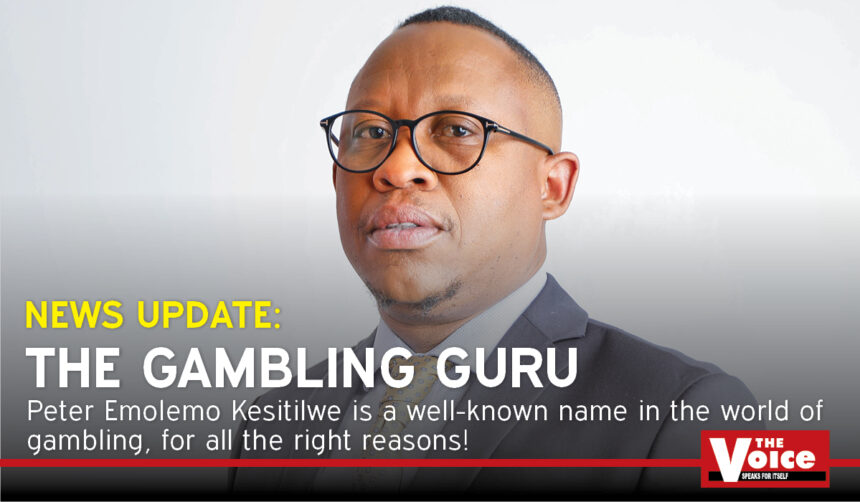
Peter Emolemo Kesitilwe is a well-known name in the world of gambling, for all the right reasons!
A proven winner at the Gambling Authority of Botswana, the 46-year-old earned a continental call-up in September, named the first ever Chief Executive Officer (CEO) of the newly-formed African iGaming Alliance (AIA).
The big gigs keep coming for the Gaborone-born Kesitilwe, who was recently welcomed on to the London-based Clarion Gaming Regulatory Advisory Board, an appointment seen as a big win for Africa.
The Voice Staffer BAITSHEPI SEKGWENG spoke to Kesitilwe about his success and his journey into the global stage.
Briefly tell us about your professional journey in the gambling industry.
I am the Chief Executive Officer of the African iGaming Alliance (AIA), a pan-African industry body representing licensed and responsible iGaming operators across the continent. I am a Fellow Chartered Accountant (FCA), a Chartered Management Accountant (CIMA) and a Chartered Global Management Accountant (CGMA), with an MSc in Strategic Business Management from Manchester Metropolitan University. I am also an alumnus of the prestigious London Business School having completed their Senior Executive Management Programme.
Professionally, I bring over 15 years of executive leadership experience across regulation, finance, governance, and digital industries in Africa. Prior to joining AiA, I served as CEO of the Gambling Authority of Botswana, where I led significant regulatory reforms, expanded licensing, strengthened responsible gambling frameworks, modernised compliance systems, and positioned Botswana as a credible and respected gaming jurisdiction. I have been a board member of both the International Association of Gaming Regulators (IAGR), Gambling Africa Regulators Forum and been an Executive Member of the Africa Regulatory Standardization Organisation (ARSO).
Wow, that’s quite the introduction! Tell us about being made Africa iGaming Alliance (AiA) CEO?
It is both an honour and a responsibility. Being the inaugural CEO means helping to define the organisation’s credibility, values, and long-term relevance. I see it less as a title and more as a stewardship role, building a trusted pan-African platform that balances industry growth with strong consumer protection.
And what exactly is the AIA?
AiA is a pan-African industry alliance representing licensed and responsible iGaming operators. Our mandate is to promote regulated markets, responsible gaming, sustainable taxation, regulatory cooperation, and the reduction of illegal gambling, while supporting governments and regulators with evidence-based policy engagement.
So do you gamble yourself?
I don’t gamble and I have never gambled. My role is purely as an industry professional focused on regulation, governance and building sustainable, well-regulated markets.
I understand you’ll be based in Johannesburg; are you a family man and won’t it be difficult being away from your loved ones?
I am married and have three daughters. Family is very important to me, and while my work involves travel and international engagement, I have worked outside Botswana before and am comfortable operating across borders. That experience has helped me maintain balance and perspective.
The limited time I get outside of work and travel is intentionally spent with my family. They are my grounding force and a key source of support; that balance is something I value deeply!
How many countries is iGaming available in?
iGaming is active or emerging in over 30 African countries, though maturity varies widely. Some jurisdictions are fully regulated, others are transitioning, and some are still informal or unregulated. This uneven landscape is exactly why a continental body like AIA is necessary, to harmonize and standardize the iGaming landscape in Africa.
What is your vision for Africa iGaming Alliance?
To become Africa’s most credible bridge between regulators, governments, policy makers and licensed operators by championing player protection, fair taxation, and market integrity, while helping Africa unlock the full economic and digital potential of regulated gaming.
As a new entity, what challenges is AIA facing, and how are you overcoming them?
The biggest challenges are fragmented regulation, misconceptions about the industry, and policy uncertainty. We are overcoming these through structured engagement with regulators (Nigeria, Benin, Uganda, Malawi, Rwanda, South Africa, Namibia, Senegal, Lesotho, Ghana, Tanzania, Kenya, Mozambique etc), partnerships with global bodies such as the International Betting Integrity Association (IBIA), whom we recently signed an MOU with, The European Gambling and Betting Association (EGBA) as well as National iGaming Associations; we have this far engaged with the Nigerian Bookmakers Association, The Zambian Bookmakers Association, the South African Bookmakers association to mention just a few. We employ data-driven advocacy, we have undertaken research, and by positioning AIA as a constructive, not-confrontational, stakeholder.
With the growing trend of illegal gambling, what is AIA’s role?
Illegal gambling is one of the biggest threats to consumers and governments. AIA’s role is to support enforcement through policy advice, promote practical licensing models, and demonstrate that over-taxation or regulatory gaps only drive players offshore. Regulation, not prohibition, is the solution.
What can Africa expect from AIA?
Africa can expect thought leadership, honest engagement, regulatory support, and industry accountability. AIA is not about defending bad actors, it is about raising standards, protecting players, and ensuring gaming contributes positively to African economies.
What are your biggest priorities for growth, and how do you measure success beyond revenue?
Our priorities are membership credibility, regulatory trust and policy impact. Success is measured by markets formalised, illegal play reduced, consumer safeguards strengthened, and constructive relationships built, not just financial metrics. It is a badge of honour to be a member of the AIA as we only accept operators who are compliant in all aspects of their licence conditions through Africa.
What are the biggest regulatory challenges when entering new markets?
The key challenges are policy uncertainty, inconsistent tax regimes, capacity constraints, and lack of technical understanding of digital gaming. AIA helps by facilitating dialogue, sharing international best practice and promoting proportionate regulation suited to African realities. Currently the AIA is helping the Zimbabwean and Lesotho governments as they are on a course to review their legislations around iGaming to grow their industry.
How important is responsible gaming to your business model and brand identity?
Responsible gaming is non-negotiable. It is central to our legitimacy, our partnerships with regulators, and our long-term sustainability. Markets that ignore player protection ultimately fail, socially, politically, and economically.
Your thoughts on the current status quo for licensing and compliance in Africa?
Africa’s interest in gambling regulation is encouraging, but licensing must be realistic, enforceable, and aligned with digital realities. Excessive fees or punitive taxes only strengthen illegal markets. Smart compliance frameworks attract investment and protect the public.
You were recently appointed to the Clarion Gaming Regulatory Advisory Board. What does this mean for you?
It is a significant professional honour. It reflects Africa’s growing relevance in global gaming conversations and allows me to bring African regulatory and iGaming perspectives into international policy and industry forums.
What will your role be?
My role is to advise on regulatory trends, emerging risks, and responsible gaming, with a particular focus on developing and transitional markets, especially in Africa.
Lastly, what is the most challenging decision you have faced as CEO, and what did you learn?
The most challenging decisions involve balancing commercial pressure with regulatory integrity. I have learned that long-term credibility always outweighs short-term convenience, and once trust is lost, it is extremely difficult to rebuild.
PERSONAL PROFILE
DOB: 18 March 1979
POB: Gaborone
FAV MEAL: Lamb curry with rice
FAV DRINK: Original Coke
FOOTBALL TEAM: Liverpool FC