

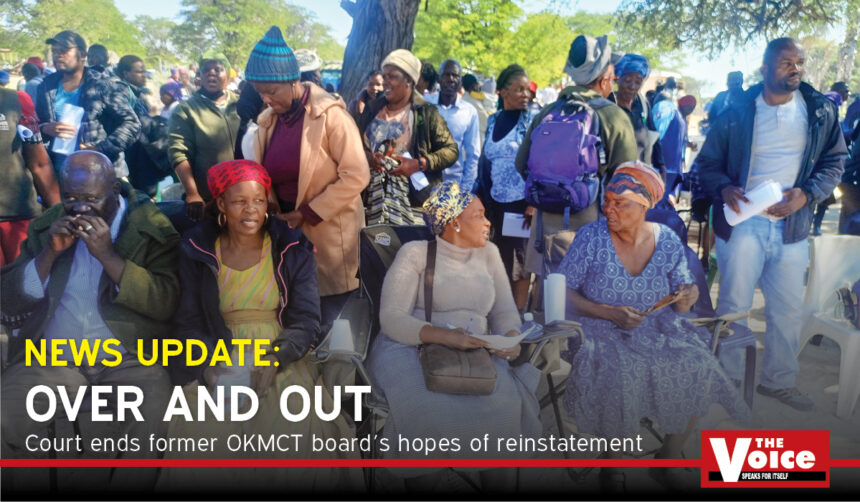
Court ends former OKMCT board’s hopes of reinstatement
The long-running battle for control of the Okavango Kopano Mokoro Community Trust (OKMCT) is finally over – at least from a legal perspective!
On Friday, the Court of Appeal (CoA) dismissed the former board’s desperate attempt to challenge their removal from office.
Ousted Chairman, Lekopanye Mokobela and 10 others wanted court to interdict the resolutions of a Special General Meeting (SGM) and prevent the Master of the High Court from recognising the newly elected board pending a full judicial review.
Having failed at the High Court, the determined group then tried their luck at the CoA. Once again, their efforts proved unsuccessful.
The Appellants, who were appointed on an interim basis in October 2024 after passing a motion of no confidence in the previous board, were chased out on 17 March through a similar vote of no confidence passed at a SGM in Boro village.

The current board were elected at the same gathering.
Unwilling to leave without a fight, the group insisted their removal was unfair, citing ‘procedural irregularities’ at the meeting.
Their gripes included: the meeting was not chaired by the board’s official chair, non-members allegedly voted and the voting process lacked transparency as those in favor of the motion were segregated from those in opposition, making verification difficult.

They also argued on appeal that the High Court had erred by issuing orders not sought by the parties, particularly those relating to the Master of the High Court’s administrative functions.
However, the three-panel CoA, led by Justice Michael Leburu, decided the SGM that removed the appellants was procedurally convened, and the voting and counting were fair and transparent.
They ruled the meeting, ‘substantially complied with the dictates of a fair electoral voting system’, especially as the Deed of Trust is silent on the specific voting process.
Furthermore, court noted that the current board has already been appointed by the Master of the High Court and is currently in office.
The court ruled that the appellants’ original tenure was set to expire in September, a finding that was not successfully challenged on appeal.
In conclusion, Justice Leburu declared, “The horse has bolted, and there is nothing to interdict. No useful purpose would be served by granting a discretionary remedy like an interim interdict at this stage.”

Adding salt to the wounds, the defeated group were also ordered to bear the costs of the application.