




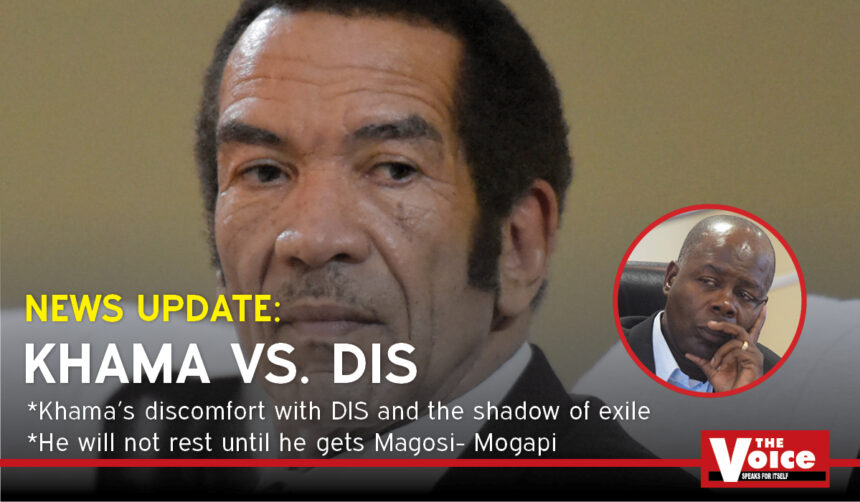
*Khama’s discomfort with DIS and the shadow of exile
*He will not rest until he gets Magosi- Mogapi
Former President Kgosi Khama IV of BaMangwato has reignited scrutiny of the Directorate of Intelligence and Security Services (DIS), demanding accountability from the very same institution he oversaw as head of state from 2008 to 2018.
This week, Khama posed a series of pointed questions to the Minister of State President, Defense and Security, seeking detailed disclosures about DIS promotions, officer deployments, and operational outputs.
In particular, the former president wanted to know if promotions complied with the Public Service Act and whether beneficiaries had appropriate qualifications.
He further questioned if DIS officers working outside central or regional offices produce tangible outputs, given that intelligence work relies on cultivating contacts and generating actionable reports.
Communications and Innovation Minister, David Tshere, responding on behalf of State President Minister Moeti Mohwasa, outlined the DIS structure but refused to disclose operations details publicly. wanted the DIS to disclose their operations including their recent accelerated promotions, whether the beneficiaries had the right qualifications, and whether the promotions were in accordance with the Public Service Act.

Khama was not impressed by the minister’s response and has reportedly decided to escalate the matter to the National Assembly through his Member of Parliament (MP) Baratiwa Mathoothe.
Former MP for Lobatse Nehemiah Modubule who was among the MPs that walked out of Parliament when the DIS Bill was debated in 2007, says DIS has been ‘operating like a government on its own terms’. “Khama’s concerns are not far-fetched. I don’t think he is doing this out of jealousy or spite, he has information. It is surprising that he is asking these questions now,” Modubule said, noting that when the DIS Act was promulgated Khama was a beneficiary.
“But then he did not want to listen, together with his BDP MPs. Members of the Parliamentary Committee that are serving are actually appointed by the President and serving his interests, and therefore it cannot be taken to be an oversight committee. That’s why some of us did not even want this Bill to go through Parliament,” he quipped.

“These loopholes they are seeing today have been in existence for a long time and he is now questioning them because he is out and Magosi is still in and I personally believe it’s a witch-hunt,” he added.
Between its establishment in 2008 and 2018, the DIS consumed an estimated P400 million annually, according to a research conducted by Kebapetse Lotshwao.
Modubule was the Chairman of the Parliamentary Public Accounts Committee (PAC) in 2013 and recalls how the founding Director General (DG) of DIS, the late Isaac Kgosi, would give them a difficult time when appearing before the Committee.
Modubule added that during Kgosi’s time, the DIS spent its entire budget to the last Thebe, something unusual with government departments.
“I recall one time I asked him as to how they managed to pay to the last Thebe and whether he could share with other ministries, as others always had over or under expenditure. The problem was that the Auditor General did not audit DIS as it was done with other government departments. They were always hiding behind the ‘sensitive nature’ of their job,” he said.
At a press conference he addressed at Cresta Lodge in Gaborone early last year, Khama publicly criticized the continuation of Brigadier Magosi in the DG role under the Umbrella for Democratic Change (UDC) government, linking him to the Khama family members’ exile in South Africa.
Among other things, the DIS confiscated Khama’s guns in 2021, only returning them after a prolonged legal tussle.

Former Chairman of Botswana Editors Forum, communications expert Spencer Mogapi says Kgosi Khama is right to hold the DIS accountable although he may be motivated by unfinished personal business.
“He is still very angry at DIS especially its current Director General, Brigadier Peter Magosi. Khama has never made it a secret that he holds Mokgweetsi Masisi and Peter Magosi personally responsible for hounding him out of the country. Only getting those two behind bars will please Khama to some degree”.
Mogapi concedes that Khama played a big role in getting Masisi to lose state power, but he feels very strongly that his job is not finished for as long as Magosi still wields some power and influence in the new government.
“That unfinished business is behind the questions he is asking. It is also the reason for his growing unease with the current government. In his worldview he got a raw deal from the guys he helped attain state power,” he said.
Khama was reportedly promoted to the rank of Brigadier at age 24, skipping many of his seniors in the newly established Botswana Defense Force (BDF). Critics have accused him of double standards, but Mogapi maintains it is unfair for some people to hold him accountable for mistakes that happened over 40 years ago, performed not by him but by his father who died 46 years ago.
“It can only be done by people who are ill-willed and who don’t want to see this country move forward”.
Meanwhile, another scholar Kebapetse Lotshwao’s article published in a journal of Policing, Intelligence and Counter Terrorism in February 2025 argues that the DIS was formed as an instrument for coercion and enjoyed a wide mandate, overshadowing other security agencies.
He states that in performing their functions, DIS agents are allowed to use force they deem necessary in the circumstances.
Although the DIS is required on one hand to obtain a court warrant to investigate threats to national security, it is also empowered on the other hand to operate without a court warrant under special exigencies.
“Regarding leadership, the DIS is headed by the Director General, who is unilaterally appointed by the president. According to the Act, the Director General is the principal advisor to the President and the Government on matters relating to national security and intelligence. It is apparent that the Act does not only give the DIS a broad mandate but also produces a close personal relationship between the President and the Director General,” Lotshwao says.