



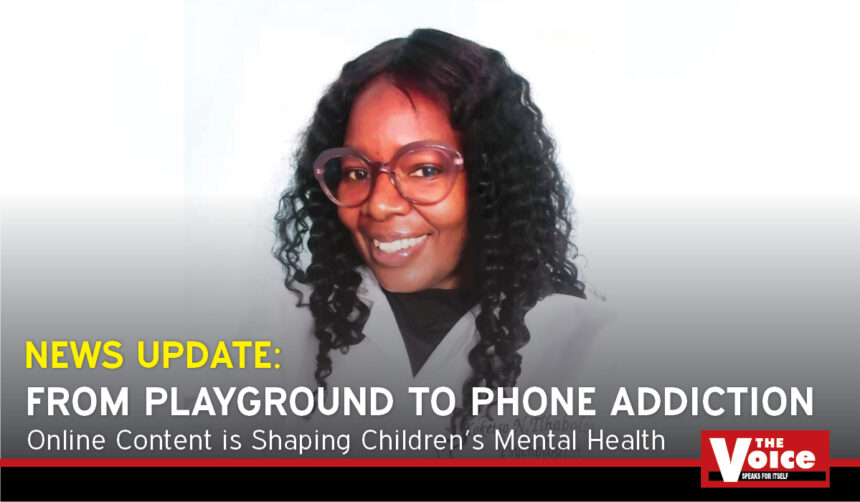
Online Content is Shaping Children’s Mental Health
In a bold move to protect children’s mental health, Australia recently passed legislation banning children under the age of 16 from accessing or using social media platforms.
Counselling Psychologist, Koketso Neo Tlhabologang, welcomes the decisive policy, describing it as a necessary intervention in a growing crisis that Botswana may also need to consider addressing with similar measures.
Tlhabologang believes that the digital content children consume daily is quietly reshaping their mental and emotional wellbeing.
“By the time a child reaches adolescence, they may have spent more hours online than engaged in meaningful face-to-face interaction. This reality is silently damaging future generations, one click and swipe at a time,” she tells Voice Woman in this timely and thought-provoking conversation.
With schools newly opened, the passionate public servant explains why what children consume online – and how much screen time they get – matters now more than ever.

An employee of the Ministry of Basic Education and Child Welfare under the Department of Special Support Services, Tlhabologang is currently pursuing postgraduate studies in psychology in Kenya, where she is also engaged in further professional development at Masari Psychiatric Hospital, working with patients ranging from young children to adults who present with anxiety, depression, schizophrenia, and related mental health conditions. Her clinical work with children as young as seven has heightened her concern about the psychological impact of digital content.
“There is a widespread assumption that depression and anxiety only affect adults,” she says. “But we are seeing children struggling deeply with emotional distress, and digital exposure is often a contributing factor.”
With years of experience working closely with learners facing psychosocial and learning challenges – including children diagnosed with autism spectrum disorder and Attention Deficit Hyperactivity Disorder (ADHD), conditions she notes are increasingly common in Botswana’s classrooms – Tlhabologang has also served as a national and master trainer for the Cycles of Support (COSI) programme, which focuses on preventing school dropouts.

“The programme identifies why learners disengage from school and mobilises community systems to keep them enrolled,” she explains.
“When a child drops out or frequently misses school, we ask what support exists around them. We work with families, schools, social welfare, health workers, and other stakeholders to ensure no child falls through the cracks.”
She adds that many learners struggle not only with learning difficulties but also with serious social challenges, including limited family support, emotional distress, and trauma.
Her role involves guiding schools and teachers on how best to support these learners.
In addition, her work extends to HIV and AIDS advocacy through the Talk Back programme, a teacher capacity-building initiative that equips educators to support learners affected by HIV-related psychosocial challenges.
Another key pillar of Tlhabologang’s work is psychological assessment in schools.

“These assessments evaluate learning abilities, emotional wellbeing, and the impact of social or family-related challenges.Sometimes learners struggle due to grief, trauma, or emotional distress. When we identify these challenges, we recommend support measures such as learning accommodations or special consideration during examinations,” she explains, adding unrestricted access to the internet has introduced a new layer of risk.
“Internet access is everywhere; in schools, homes, clinics, and public spaces. Children have access to smartphones, tablets, and computers, often without supervision. But how often do we ask: what they are actually consuming?” she asks rhetorically.
According to Tlhabologang, children are exposed to online games, social media platforms, gambling sites, nefarious schemes of online predators,and video content that may be inappropriate for their developmental stage.
She notes that online gambling, in particular, is becoming a growing concern.
“Some children present with unexplained stress, mood changes, or withdrawal. In some cases, it turns out they’ve been betting online and losing money. The emotional toll can be severe.”
She also highlights how social media distorts self-imageamong young people. “Children and teenagers are constantly exposed to unrealistic portrayals of beauty, success, and lifestyle.
They lack the emotional maturity to distinguish reality from staged content, which leads to comparison, low self-esteem, and emotional pressure,” she explains.
Excessive screen time, she warns, is linked to anxiety, depression, aggression, poor sleep, and reduced emotional regulation.
“It also affects empathy and interpersonal skills. Children who spend most of their time online miss out on real-life socialisation. This affects brain development, problem-solving abilities, and emotional intelligence.”
Tlhabologang adds that exposure begins far earlier than many parents realise.
“Children as young as two or three are consuming digital content, cartoons and videos whose messages parents often have not taken the time to fully understand. That content can influence mood, behaviour, and psychological development,” she says, adding she is particularly concerned about cyberbullying and the pressure children feel to keep up with peers through expensive gadgets and online trends.
“Children are now asking for high-end smartphones that sometimes cost more than their school fees. This pressure contributes to anxiety and feelings of inadequacy.”
Despite these concerns, Tlhabologang is careful not to demonise technology. “Technology is not the enemy. There are excellent educational tools online. The problem is unregulated, excessive, and unsupervised use,” she says.
Her message to parents and caregivers is simple but urgent: monitor, limit, and engage.
“Parents need to take an active interest in what their children are consuming online. Have conversations. Set boundaries. Be present,” she advises.
As a mother to a teenage son, Tlhabologang acknowledges that this is not always easy.
“We are often just as attached to our devices. But if we do not model healthy digital behaviour, our children will not learn it,” she admits.
She believes addressing children’s digital consumption is essential to tackling broader mental health challenges in Botswana and beyond.
“If we want emotionally healthy children, we must look at their online environments as seriously as we look at their physical ones. What they consume today is shaping who they become tomorrow,” she says in conclusion.